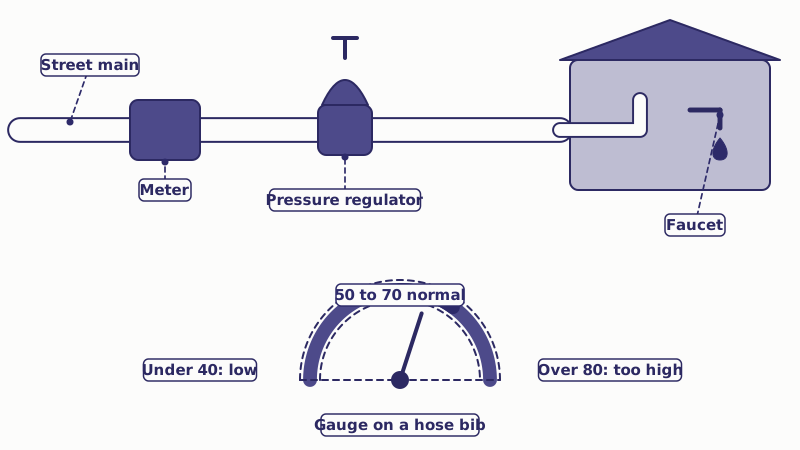
A plumber for low water pressure starts with a gauge, not a guess. Static pressure at a hose bib tells them whether the supply is weak, the regulator has failed, a valve is partly closed or the pipes have narrowed with scale. Most cases come down to one of those four, and each has a different fix and a different price.
We'll arrange for a local plumber to come to your home and give you a written quote before any work starts. This page explains what the visit covers and what the work costs. Back at the main page for City of Angels Plumbing, you will find our other services.
What does a plumber do about low water pressure?
A plumber fits a gauge to an outdoor tap and reads the static pressure, then compares it with readings at the main valve and inside the house. They check the main shut-off and meter valve, the regulator and its strainer, the fixtures, and the pipe material, and then fix whatever is restricting the flow.
The usual fixes, from cheapest to dearest:
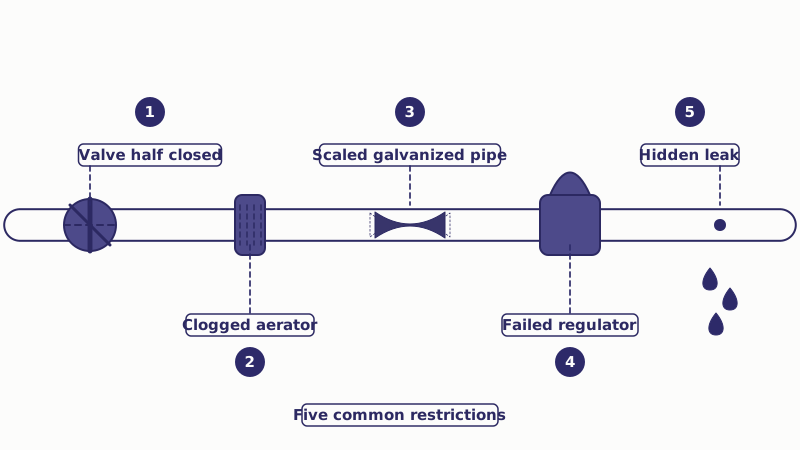
- Open a valve that is partly closed. A main or meter valve left a turn short after other plumbing work can cut pressure at every tap.
- Clean or replace a clogged strainer or aerator.
- Replace or reset the pressure regulator. See the water pressure regulator guide.
- Replace a shut-off valve that is worn out. See the cost of replacing a shut-off valve.
- Repipe old galvanized lines where scale has narrowed the pipe. See galvanized pipe replacement.
- Find a leak. A hidden leak lowers pressure and raises the water bill. See why your water bill is so high.
If you want to see the causes in more detail, read why your water pressure is low.
How do I check my water pressure, or the pressure in my area?
Screw a pressure gauge onto an outdoor hose bib, turn the tap on fully and read it. Healthy pressure at a house is usually 50 to 70 psi, and anything below about 40 psi is low. For your area, LADWP gives the maximum and minimum pressure for any address it serves, at no cost, calculated from ground elevation.
LADWP takes the request by email to the water distribution district for your address. Its pressure page explains how to find the district. That figure is the main pressure outside the house, and it will be higher than what you see at a tap, because the regulator reduces it.
If you suspect an outage or main work, ask neighbors whether they have the same problem, and contact LADWP. A street-wide drop is the utility's problem. A drop that affects one house is yours.
Pressure rises at night when demand falls, so test at different times. A reading that jumps from 60 to 95 psi overnight means the regulator is not holding. A reading under 40 psi all day means a restriction.
Why is low water pressure a problem, and is it dangerous?
Low pressure is rarely dangerous by itself, but it is a symptom worth checking. It can point to a hidden leak, a failing regulator or corroded pipe, and a very low reading can stop a tankless water heater from firing. The more serious risk in many Los Angeles homes is the opposite: pressure above 80 psi that strains pipes and fixtures.
A sudden fall across the whole house is worth acting on within a day or two. Look at your meter with every tap off: if it keeps moving, there is a leak. A fall that affects only the hot side points to the water heater. See no hot water if the heater is the suspect.
If you meant blood pressure, that is a medical question for a doctor and not something a plumber can help with.
What causes low water pressure in a Los Angeles home?
The common causes are a partly closed valve, a failing regulator, scaled galvanized pipe in older homes, a hidden leak, hard water scale in fixtures, and low pressure at the street, especially on hillsides. Every 2.31 feet of elevation above the main costs about 1 psi, so homes high on a slope start with less.
Older homes make a difference. Many Los Angeles houses built in the 1920s to the 1950s have galvanized steel supply pipes that scale up inside with age, and a pipe that was once three-quarters of an inch wide can behave like a much smaller one. LADWP also reports that hardness varies across the city, from an average of 147 mg/L as calcium carbonate in the San Fernando Valley and western Los Angeles to 279 mg/L in the east and the Harbor area, which affects how fast fixtures and heaters scale up.
Not all low pressure is the plumber's problem. If the whole street is low, only the utility can raise it.
How do you increase water pressure at home?
First fix what is restricting it: open the valves fully, clean aerators and showerheads, and have the regulator checked. Raising the regulator setting helps only if it is set too low, and it must stay at or under 80 psi, the code limit. A booster pump is a last resort and needs a plumber, because it can overpressure pipes.
Our guide to how to fix low water pressure in the house goes through the steps. For one weak spot, see low water pressure at the shower head, kitchen sink pressure and low pressure in a bathroom sink.
For a shower that is weak because of the head, our article on the best showerhead for low water pressure explains what to buy under California's 1.8 gpm limit.
Sprinklers need a different approach. Irrigation zones that run low on pressure usually need a smaller zone, a pressure-regulating head or a separate line, and a plumber or irrigation specialist should look at the layout before you add heads.
Is a water pressure regulator necessary, and what psi should it be?
Yes, where pressure would exceed 80 psi. The California Plumbing Code, section 608.2, requires a regulator in that case, and LADWP says residential regulators are normally set between 50 and 70 psi. A regulator also needs a strainer and, after it, an expansion tank on the cold water side.
The typical price to replace a regulator is about $200 to $700, according to Angi and HomeAdvisor, with an average near $400. A simple repair or adjustment is $75 to $200. More detail is in our guide on the water pressure regulator, and prices for valves are in the shut-off valve cost guide.
How much does a plumber for low water pressure cost?
A diagnosis and a minor fix such as a valve, strainer or regulator adjustment usually falls between $75 and $400. A regulator replacement is about $200 to $700. A repipe is a bigger job and is priced by the size of the house. These are guides from published prices, and your written quote is the real number.
| Job | Guide range |
|---|---|
| Service call and diagnosis | $75 to $150 |
| Regulator adjustment or simple repair | $75 to $200 |
| Regulator replacement | $200 to $700 |
| Main shut-off valve replacement | $150 to $800 |
| Plumber hourly rate | $85 to $150 |
Figures come from Angi and HomeAdvisor cost guides and published prices of plumbing businesses, checked in November 2026. For service-call fees alone, see plumber service call cost.
Cheapest is not the same as best. A low price that leaves the fault in place costs more in the end. Ask what the quote covers and compare the same scope.
How do I find a good plumber and avoid being overcharged?
Ask for the plumber's California contractor license number and check its status on the Contractors State License Board website before you agree to work. Get the quote in writing. California requires a written contract for home improvement jobs over $500, and the down payment cannot exceed $1,000 or 10 percent of the price, whichever is less.
Some other habits that protect you:
- Get the fault named. A good quote says what is wrong, what will be done and what it costs.
- Be careful with flat phone prices. A plumber cannot price a pressure problem without measuring it.
- Ask for the old part, and ask for pressure readings before and after.
- Compare scope, not only price. A repipe quote and a valve quote are different jobs.
To start, use the quote page and describe the problem. For a wider guide, see the best rated plumber and how much a plumber charges per hour.
Common questions
What is the 135 rule in plumbing?
We could not find a plumbing code rule by that name, so we will not guess at it. Ask whoever used the term what it refers to. For pressure, the rule that matters is the California Plumbing Code limit of 80 psi, and for water heaters, the usual home setting of about 120 degrees.
How do you adjust a PRV?
A pressure-reducing valve has an adjusting screw or bolt under a cap. Loosen the lock nut, turn the screw a quarter turn clockwise to raise pressure or counterclockwise to lower it, and read a gauge at a hose bib after each turn. Keep it between 50 and 70 psi and below 80, and call a plumber if it will not hold.
Which word is silent in plumber?
The letter b. The word plumber comes from the Latin word for lead, plumbum, which is why the b is in the spelling even though nobody says it aloud. People also search for it as plummer, and we sort out which spelling is right on our page about plummer or plumber.
How long does a plumber take to fix low water pressure?
A valve, strainer or regulator fix is often done in one to two hours once the plumber has measured the pressure. Finding a hidden leak can take longer, and a repipe takes days. Ask for a time estimate when you get the written quote, after the plumber has seen the pipes.
Does someone need to be at the property?
Yes, or someone you trust. The plumber needs access to the main valve, the regulator, the meter and a tap for the gauge, and the water goes off for a short time during repairs. Unlock gates and clear the way to the valve and any crawl space hatch before the visit.