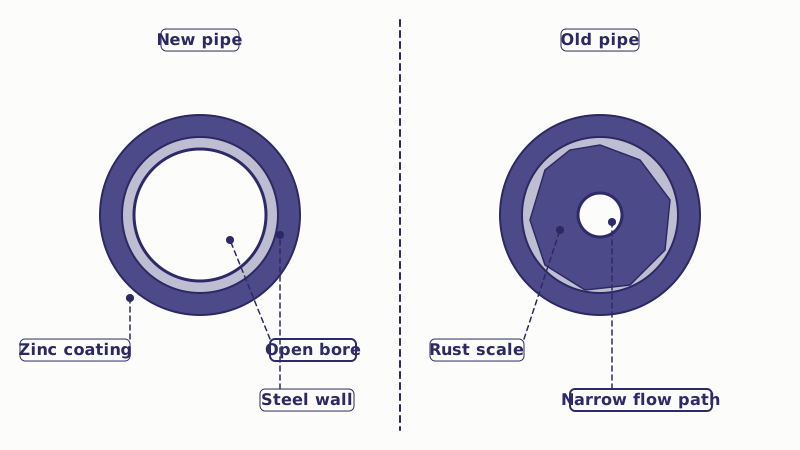
Galvanized pipe is steel coated in zinc, and it was the standard for house water lines across California until roughly the 1950s. The zinc wears off, the steel rusts from the inside, and the pipe narrows. Replacing it means repiping, almost always with PEX or copper. This page sits under our wider guide to repiping a house in Los Angeles and focuses on the galvanized case: how to confirm it, when to act and what to expect.
How do you know if you have galvanized pipes?
Galvanized pipe is dull gray, magnetic, threaded at the joints and heavier than copper. Check where the water line enters the house, under sinks and near the water heater. A magnet sticks to galvanized steel but not to copper or plastic. Scratch an inch of pipe with a key: silver-gray under the paint means steel, and a copper color means copper.
Look at the fittings too. Threaded elbows and unions are typical of galvanized lines, while soldered joints with a shiny or green-blue tint are copper. Many older houses are mixed, because a past owner replaced a bathroom or a section. Brass or copper pieces spliced into steel can corrode at the joint where two metals meet, which is a known failure point.
Only the water supply uses galvanized steel. If your house also has cast iron drains, which is typical of Los Angeles houses from the 1920s through the 1950s, they are a separate system and a separate decision.
Why does galvanized pipe fail?
The zinc coating wears away from the inside, then the steel underneath rusts, and rust scale builds up until the pipe narrows and leaks. Sources commonly put the working life at 40 to 60 years, shorter where water is hard or the pipe runs underground. Threaded joints usually go first.
Los Angeles water chemistry matters. LADWP reports average hardness of about 8.6 grains per gallon in the Valley and Western Los Angeles, about 9.8 around Silver Lake, Downtown and South Los Angeles, and about 16.3 in Eastern Los Angeles and the Harbor, per its 2022 figures. Hard water leaves scale, and mineral buildup accelerates narrowing. Water softening does not rebuild lost pipe wall. In fact LADWP notes softened water can be more corrosive to plumbing.
You cannot judge the inside by looking at the outside. A pipe that looks fine can be nearly closed at the threads.
What are the signs galvanized pipes need replacing?
Rusty or brown water on first use in the morning, low pressure at several fixtures at once, leaks at threaded joints, flaking orange at fittings and water that sputters are the common signs. One leak on a sound line is a repair. Repeated failures along the system mean the whole line is near the end.
Low pressure from corrosion usually shows up everywhere, with hot and cold both weak, and it gets worse over time. If only one faucet is weak, the aerator or cartridge is the first suspect, which the page on low water pressure walks through. A water pressure regulator problem looks different again and is explained under water pressure regulators.
Brown water that clears after a minute may be a recently disturbed pipe. Water that stays rust-colored or stains fixtures is worth a plumber's visit. Ask a plumber to cut out a short sample. Seeing the inside of a section tells you more than any test from the outside.
Does galvanized pipe contain lead?
Modern galvanized pipe is not a lead pipe, but the zinc coating can contain traces of lead, and corroding galvanized plumbing can hold onto lead from upstream sources and release it later. LADWP states that the water it delivers has no lead and says lead in home water comes from sources like old faucets and lead solder in house plumbing.
That means a test is useful when you have old plumbing, and your water utility can tell you how to get one. Do not assume a house is fine because the water source is clean. If you have a child or a pregnancy in the house and a galvanized system, ask a plumber about replacing the line and ask the utility about testing. The authority to check is LADWP's water quality office, and the CDC and EPA publish guidance on lead in plumbing.
What does galvanized pipe replacement cost in Los Angeles?
A whole-house repipe out of galvanized pipe typically runs about $4,000 to $15,000 nationally, and for a 2,000 square foot, two-bath house about $4,000 to $10,000 in PEX and $8,000 to $18,000 in copper, per published guides. Los Angeles access and finish work can push it up.
Galvanized houses can cost more than other repipes in one respect: old steel fittings are often frozen with rust and break when disturbed, which means cutting in a new section takes more care and more access. Plaster-and-lath walls in 1920s houses are slower to open than drywall. Plumbers sometimes leave the old steel in the walls, capped.
For the full breakdown of line items, see the repipe house cost page. If an old house also needs a rebuild of other systems, replacing plumbing in an old house covers it. This page shares one budget line with every repipe: get a written quote.
Can you repair galvanized pipe instead of replacing it?
Sometimes, as a stopgap. A single leak at a joint on an otherwise sound line can be repaired, and a plumber can tell you how much life the rest has. But when the leak is the third one in the past year, or the pressure is already poor, spot repairs buy little time and the next failure may be inside a wall.
Be careful with mixing metals. Connecting galvanized steel directly to copper without the right fitting causes galvanic corrosion at the joint, which is why plumbers use dielectric unions or transition fittings. That is one more reason repairs on old lines are harder than they look.
DIY has a hard limit. Replacing a pipe inside a wall or any change to the supply system calls for a permit from LADBS and, unless you are an owner-builder on your own home, a plumbing contractor. Check the plumber's license at cslb.ca.gov. The permit and inspection are covered in our guide to repiping a house.
What replaces galvanized pipe?
PEX is the usual replacement because it is cheaper, quicker to install and does not corrode. Copper is the other common option and lasts longer in many conditions, at a higher price. The choice is covered in PEX versus copper. Either one will restore the pressure the corroded steel took away.
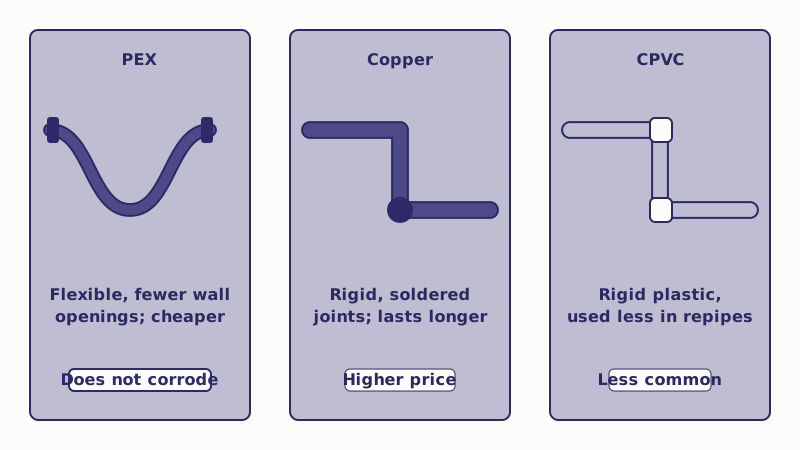
CPVC, a rigid plastic, also exists but is used less in repipes. PEX can be put in with fewer wall openings, which matters in an older house with plaster walls. The old steel pipes are normally capped and left in place unless they are accessible, as a quicker and cheaper option than hauling them out. Ask the plumber which pipes will be abandoned.
Common questions
How long do galvanized pipes last?
Most sources put galvanized steel water pipe at about 40 to 60 years, with hard water, underground runs and poor installation shortening that. A house with its original galvanized lines from the 1940s or 1950s is already past that window, so plan for replacement rather than waiting for the next leak.
How much does it cost to replace galvanized pipes in a house?
Published guides put a whole-house repipe at about $4,000 to $15,000, with PEX at the lower end and copper at the upper. Access, plaster walls, a second story and a slab foundation raise it. These are guides, and the written quote after a visit is the real figure.
Do I need a permit to replace galvanized pipes in Los Angeles?
Yes. Replacing the water supply lines in a Los Angeles house needs a LADBS plumbing permit and an inspection before walls close. The plumber normally pulls it. Ask to see it in the quote, and ask what the inspection involves before the walls are closed up.
Is galvanized pipe dangerous?
Not by itself in the short term, but corroded galvanized pipe can restrict flow, leak inside walls and in some cases hold or release lead. LADWP says the water it delivers has no lead, and that lead in homes comes from household sources. Test the water if you have concerns, and replace failing lines.
Can galvanized pipes be left in the walls?
Often yes. Plumbers commonly cap the old pipes and leave them behind the walls, then run new PEX or copper through new paths. That avoids tearing out plaster. Make sure the old lines are disconnected from the water supply and capped, so they cannot leak into the wall later.
Ready to price it? The quote page is the place to ask for a written quote after a visit, and why repipe a house lays out when waiting stops making sense.