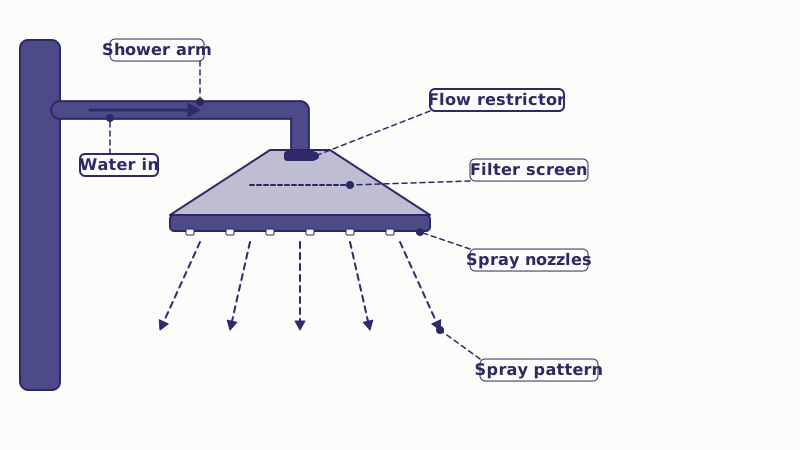
The best showerhead for low pressure is a California-compliant head rated at 1.8 gallons per minute or less that is built to speed the water up: a small number of fine nozzles, or a design that mixes in air. We cannot name a single winner, because the right choice depends on your pipes. First check that the head itself is not the problem.
A clogged head or a weak supply look the same in the shower. This page sorts the two, and it belongs to our guide to a plumber for low water pressure.
What is the best showerhead for low pressure water?
Look for a head rated at 1.8 gpm or less, with a small spray face and fine nozzles, labeled for low pressure, with a removable flow restrictor if you need to adjust it. Wide rain heads spread the same water over a large area and feel weakest on a weak supply. A smaller head concentrates the flow.
Three designs work well on low pressure:
- High-velocity or jet-style heads. Narrow nozzles speed the water up, so a thin stream feels firmer.
- Aerating heads. They mix air into the water to make the spray feel fuller. They cool the water a little on the way to your skin.
- Pressure-compensating heads. They hold the flow steady across a range of pressures, which helps if the supply varies through the day.
California limits showerheads to 1.8 gpm at 80 psi under the 2025 Plumbing Code and the green building code. The federal WaterSense label allows up to 2.0 gpm, so a head sold elsewhere may not meet California's rule. Buy a head marked as California compliant.
Be skeptical of claims that a head will double your pressure. A showerhead cannot add pressure. It can only change how a limited flow is shaped.
Why is my shower pressure low in the first place?
The cause is usually a clogged showerhead, a partly closed valve, a worn shower cartridge, a failing pressure regulator, scaled pipes or low pressure in the street supply. If every tap in the house is weak, the problem is the supply. If only the shower is weak, the head or the shower valve is the suspect.
Work through them in order:
- Unscrew the head and run the shower without it. If the flow is strong, the head is the problem. If it is still weak, look further back.
- Soak the head in white vinegar for an hour or two, then brush the nozzles. Mineral deposits are the usual cause. LADWP notes that minerals in heated water can clog showerhead and faucet screens.
- Check the shower valve cartridge or mixing valve. A worn one restricts flow on the hot or the cold side.
- Check for a hot-only problem. If only the hot side is weak, the water heater's valve or sediment is the likely cause.
- Check every other tap. If they are all weak, see why your water pressure is low.
Hard water is a factor in Los Angeles. LADWP reports average hardness of 147 mg/L in the San Fernando Valley and western Los Angeles, 168 mg/L in the Silver Lake, downtown and South Los Angeles area, and 279 mg/L in the east and Harbor area. The harder the water, the faster the nozzles fill with scale.
Our page on low shower water pressure goes deeper on the plumbing causes.
How do I test the flow without special tools?
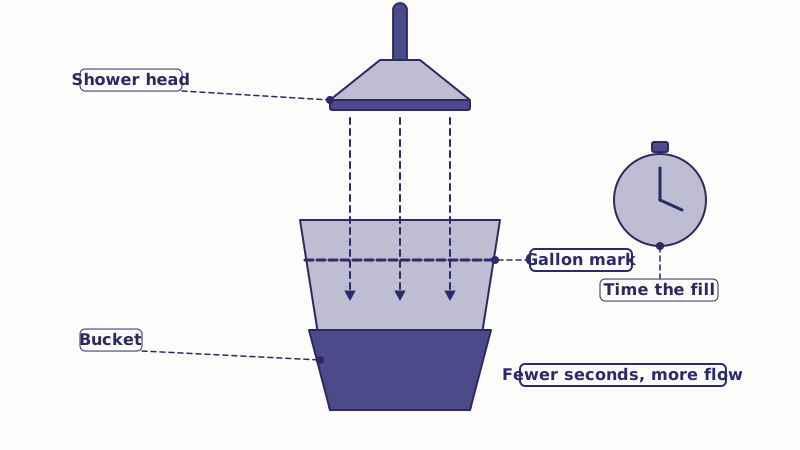
Take the showerhead off, hold a one-gallon bucket under the open pipe, turn the water on fully and time how long it takes to fill. A fill time of about 33 seconds equals 1.8 gpm. If it takes much longer, the supply is restricted, and a new showerhead will not fix it.
A pressure gauge on a hose bib is a better test. It reads static pressure, the number that matters for the regulator rules. LADWP says residential regulators are normally set between 50 and 70 psi. A reading under about 40 psi suggests a problem upstream.
Test in the morning and in the evening if you can. In some neighborhoods demand changes the supply pressure through the day.
Hillside homes in Los Angeles often have lower pressure than flat-land homes, because every 2.31 feet of height costs about 1 psi. If your house sits well above the street, the second floor may have noticeably weaker showers regardless of the head.
Should I remove the flow restrictor?
Removing the restrictor makes the head use more water than its rating, and it is not a fix we would suggest. In California the limit is 1.8 gpm, and a restrictor-free head can use well over that. Try cleaning the head, changing to a high-velocity head and checking the supply first.
If you decide to experiment with a head you own, keep in mind that more flow on a weak supply may just drain the hot water faster. If your problem is hot water running out, see why you have no hot water.
Multiple outlets matter too. For a shower with several heads on one valve, California's green building code limits the combined flow to 1.8 gpm at 80 psi, unless the design lets only one outlet run at a time. A shower with body sprays and a rain head will feel weak for that reason, whatever the supply.
When should I call a plumber?
Call a plumber if every tap is weak, if the shower is weak after cleaning and swapping the head, if pressure fell suddenly, or if you hear banging. A plumber measures static pressure, checks the regulator, valves and pipes, and tells you if the shower valve or the water heater is at fault.
Older Los Angeles homes with galvanized steel supply lines are a common source of pressure that no showerhead will fix, because the pipe scales up inside. If your house dates from before the 1960s, ask the plumber to check the pipe material. See galvanized pipe replacement.
A failing regulator is another cause. A water pressure regulator that has stuck partly closed starves the whole house. For a written quote, use the quote page and describe what the shower does and what you have tried.
Common questions
How long does it take to fit a new showerhead?
Five to ten minutes. Unscrew the old head by hand or with a wrench wrapped in a cloth, clean the threads, wrap them with plumber's tape in the direction of the thread, and screw the new head on hand-tight. Run the water to check for leaks. If the arm is loose or corroded, call a plumber.
What should I ask before I hire a plumber for weak shower pressure?
Ask them to measure static pressure at a hose bib and at the shower, so the problem is located. Ask whether the price includes checking the regulator and the shower cartridge, and what the repair options are. A written quote that names the fault is better than a flat figure.
Does someone need to be at the property?
Yes, or someone you trust. The plumber needs access to the bathroom, the main shut-off and perhaps the regulator. If the shower valve is behind a wall, expect some tile or panel work to be discussed before it is done.
Will a low-flow showerhead make my pressure worse?
A low-flow head cannot lower the supply pressure, but it can feel weaker if it spreads water over a wide face. Pick a model with a smaller spray face and fine nozzles. In California all new showerheads must be 1.8 gpm or less anyway.
Does a handheld showerhead help with low pressure?
It can feel stronger because the spray face is smaller and you can aim it closer to your body. It will not raise the flow, and a diverter that splits water between a handheld and a fixed head can reduce the flow to each. Use it as a convenience, not a fix.