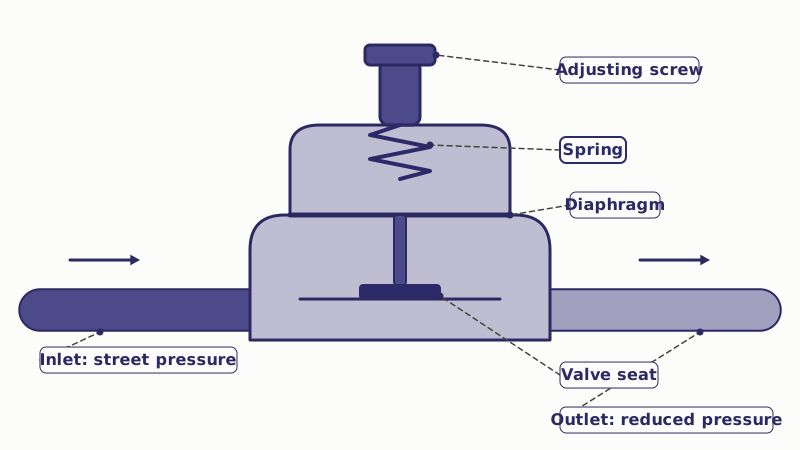
Yes, in most Los Angeles homes a water pressure regulator is necessary. The California Plumbing Code requires one when static pressure in the supply piping exceeds 80 psi, and LADWP says new residential plumbing in the City of Los Angeles needs one wherever main pressure can go above 80 psi. Most regulators are set between 50 and 70 psi.
This page explains the rule, the setting, the signs of a failing regulator and what to do about them. It is part of our guide to a plumber for low water pressure, because a worn regulator is one of the causes that guide covers.
Is a water pressure regulator necessary?
Yes, where the pressure would otherwise exceed 80 psi. The 2025 California Plumbing Code, section 608.2, says an approved regulator with a strainer must reduce static pressure to 80 psi or less. LADWP says older homes may have none, even where street pressure is above 80 psi, because they were built before the current rule.
High pressure does quiet damage. It strains supply lines, washing machine hoses, toilet fill valves, faucet washers and water heater connections, and it is a common reason for banging pipes and short appliance life. If your house has no regulator and sits low on a slope, ask a plumber to measure.
Pressure at the street depends on elevation and the zone, so it varies across the city. LADWP gives the maximum and minimum pressure for any location it serves, at no cost, calculated from ground elevation. You can ask for the numbers for your address through the LADWP water services pressure page.
Not every home needs one. In a house where the main pressure never exceeds 80 psi, the code does not require a regulator, though many plumbers fit one anyway. The only way to know is to measure.
What psi should a water pressure regulator be set at?
Set it between 50 and 70 psi. LADWP says residential regulators are typically adjusted within that band, and the plumbing code caps static pressure at 80. A setting around 55 to 60 psi feels strong in the shower and is gentle on pipes, though your own best setting depends on how many floors the house has.
Within the band, taller houses need a little more. Every 2.31 feet of height costs about 1 psi, so a second-floor bathroom has roughly 5 psi less than the ground floor. A hillside home can also see a big gap between the street and the house.
Do not turn the regulator up to chase pressure beyond 70. If the pressure is poor even with the regulator at a normal setting, the cause is elsewhere: a partly closed valve, a clogged strainer or corroded pipes. See why your water pressure is low.
Adjusting is a quarter turn at a time, with a gauge fitted, and by a plumber if you are not sure of the model. Our page on how to fix low water pressure in the house explains how.
Where is the regulator and what does it look like?
Most regulators are a bell-shaped brass fitting on the main water line, close to where it enters the house, often just after the main shut-off valve. In Los Angeles it may be in a front yard box, a garage wall, a crawl space or beside the water heater. The code asks for it to be accessible.
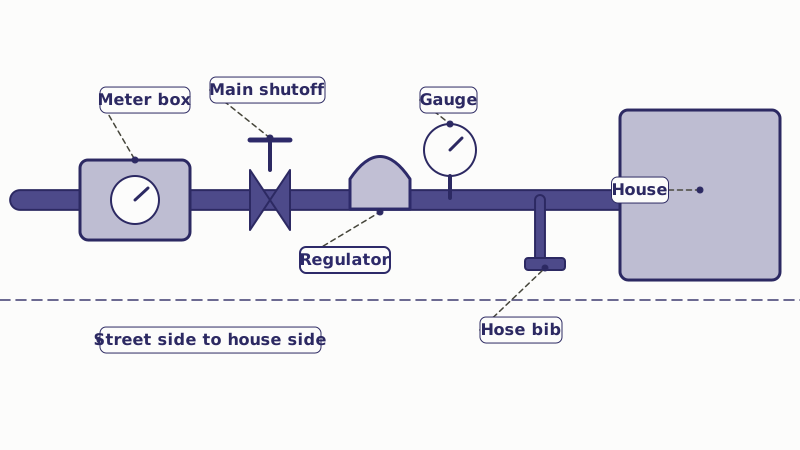
The same code section requires a strainer in front of the regulator, which catches debris before it jams the valve. It also requires an expansion tank in the cold water piping after the regulator, to absorb thermal expansion when the water heats up. If your heater has a small tank on top of it or on the pipe nearby, that is the expansion tank. See water heater expansion tank replacement.
If you cannot find the regulator, it may not exist. Many older homes have only a shut-off valve at the meter and another at the house.
What are the signs of a failing regulator?
The signs are pressure that is too high, too low or erratic: banging pipes and a hissing toilet, a fall to a trickle, or a swing between strong and weak during the day. A pressure gauge screwed onto an outdoor hose connection, with the water on, gives the real number in a minute.
Look for:
- A reading above 80 psi. The regulator is stuck open, or there is none.
- A reading below 40 psi at every tap while the street supply is fine. The regulator may have failed closed, or its strainer is clogged.
- Pressure that rises at night. Neighborhood demand falls, and the supply pressure rises. A good regulator masks this.
- Water hammer, a banging pipe when a valve closes. Read about water hammer sounds.
- A high water bill or a running toilet can come from high pressure forcing water through worn parts. See why your water bill is so high.
Regulators wear out. A plumber will often suggest replacing one that is old rather than adjusting it, since the internal spring and diaphragm weaken over time.
Why is my water pressure low inside the house but not outside?
In some homes the outside taps or irrigation are plumbed ahead of the regulator, so they show full supply pressure while the house shows what gets through it. If the hose bib is strong and every tap inside is weak, suspect a failed regulator, a clogged strainer, a half-closed valve or corroded pipe inside the house.
Check these in order. Make sure the main shut-off and the meter valve are fully open, since a valve left a turn short after plumbing work cuts pressure sharply. Then check the strainer and regulator. Then look at the pipe: galvanized steel supply lines in older Los Angeles homes scale up from the inside and narrow the flow. See galvanized pipe replacement.
A small gauge at the hose bib is useful, but one at a tap inside is better. The gap between the two tells a plumber where the restriction sits.
Why is pressure low in cold weather or suddenly?
In Los Angeles freezing is rare, so cold weather alone seldom changes pressure. A sudden drop is more often a regulator that has failed, a valve that was bumped, a leak, or work on the street main. Check whether neighbors have the same problem, and call LADWP if the whole street is affected.
If the pressure has dropped and your bill has risen, look for a leak. If it has dropped only on the hot side, the water heater or its valve is the suspect. And if you are on a private well, which is uncommon in the city, a failing pump or pressure tank is the first thing to check.
How much does a water pressure regulator cost?
Angi puts the national average for replacing a regulator at about $400, with most homeowners paying $200 to $700, and simple repairs $75 to $200. HomeAdvisor gives a similar range. Los Angeles labor rates may sit above the national average, so use these as a guide and rely on the written quote.
The part is usually $50 to $250, and the rest is labor, access and extras such as a gauge, a new shut-off valve or an expansion tank. More detail, including shut-off valves, is on our page about what a plumber charges to replace a shut-off valve. To arrange a visit, use the quote page.
Common questions
How long does a water pressure regulator replacement take?
Usually one to two hours if the regulator is easy to reach, according to HomeAdvisor. A tight crawl space, a corroded pipe or a missing shut-off valve can add time. The plumber will turn off the water to the house, so plan for a short interruption.
What should I ask before I hire someone for a water pressure regulator?
Ask them to measure the static pressure before and after, and to show you the readings. Ask whether the price includes a strainer, a gauge and an expansion tank, and whether a permit applies. Ask what setting they will use and why. A good plumber gives the number in writing.
Does someone need to be at the property?
Yes, or someone you trust. The plumber needs access to the main shut-off, the regulator and a tap or hose bib for the gauge. The water goes off for a time, so plan around it. If the regulator is in a locked garage or a yard box, make sure it can be reached.
Can I adjust the regulator myself?
Many regulators have an adjusting screw under a cap. Turning it clockwise raises the pressure. Do it a quarter turn at a time, with a gauge on a hose bib, and never above the code limit of 80 psi. If it will not hold a setting, the regulator needs replacing.
Does a regulator reduce water flow?
A working regulator reduces pressure but not the available flow. A shower may feel gentler at 55 psi than at 90, and that is the point. If flow is poor at normal pressure, the regulator may be undersized, failing or clogged, or the pipes are restricted.