If your apartment building has no hot water, the owner or manager is responsible for restoring it, and California treats a missing hot water supply as a habitability problem. Tell the manager in writing today, keep a copy, and give them a short, specific deadline. If nothing happens, you can complain to the Los Angeles Housing Department. This page explains the steps, and what a plumber checks on a building-wide water heater system. It is general information, not legal advice.
Is no hot water in an apartment a maintenance emergency?
Yes, in practice. California Civil Code 1941.1 lists a water supply that is capable of producing hot and cold running water among the conditions that make a unit untenantable, and the Los Angeles Housing Department treats no hot water as urgent. The statute says "a reasonable time" for repairs without naming days, so a total outage should be reported and fixed within days, not weeks.
Practitioner guidance often puts a full loss of hot water at a same-day to 72-hour response. That is advice from lawyers and property managers, not statutory text. A single slow tap or a lukewarm shower is less urgent than no hot water at all, and a landlord will argue about the difference, so describe your problem exactly.
Who has to fix the hot water in my building?
The landlord. The water heater, boiler and pipes of a building belong to the owner, and the owner pays for repairs unless the tenant caused the damage on purpose. A lease clause that says otherwise does not remove the duty, according to law firm summaries of the habitability rules. Your job is to report the problem; the owner's job is to hire someone.
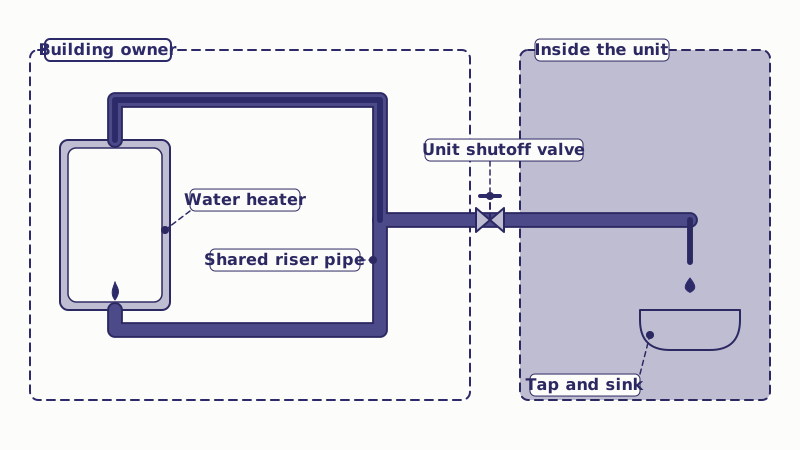
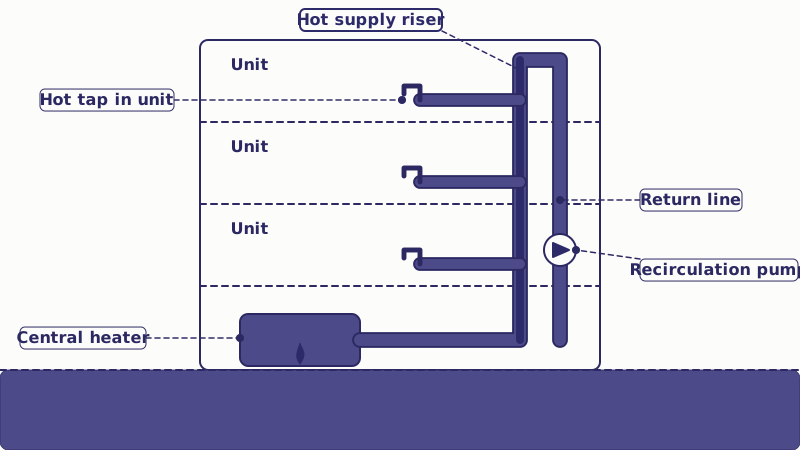
Most Los Angeles apartment buildings have one of two systems. Many older buildings use a central boiler or a large commercial gas water heater that feeds every unit through a recirculation loop. Newer buildings and some small complexes use an individual water heater per unit, often in a closet or on a balcony. The system decides who has the problem, and who can fix it.
What should I do first when the whole building has no hot water?
Check whether it is just you, then put the report in writing. Ask a neighbor, and look at your own faucets: if cold works and hot does not, in more than one unit, the source is shared. If you have your own heater in the unit, look for a tripped breaker or an out pilot, which are quick checks.
Then send one written message. Include these items:
- The date and time hot water stopped.
- Which units or floors are affected, if you know.
- A clear request to repair, with a date by which you expect an answer.
- Photos or a note of any water temperature you measured.
Keep a copy. Text and email count as a record, and a dated paper letter is better if you may need it later. Do not stop paying rent without legal advice, because the rules on withholding are strict. A tenant lawyer or a local tenant rights group can tell you what applies to your situation.
How do I report a building with no hot water to the City of Los Angeles?
Complain to the Los Angeles Housing Department, which runs the Systematic Code Enforcement Program for apartment buildings. LAHD takes habitability complaints online and by phone at 866-557-7368, and it lists no hot water as an urgent complaint type. An inspector can order repairs, and a building that ignores them can face further enforcement.
Condominiums are different. A City Council office notes that complaints about condominiums go to the Department of Building and Safety instead, since LAHD covers rental apartment complexes. If you are unsure which applies, call 311 and ask.
Two other California rights are worth knowing about:
- Repair and deduct (Civil Code 1942). If the landlord fails to fix an untenantable condition within a reasonable time after notice, a tenant may pay for the repair and deduct it from rent. The deduction is capped at one month's rent and can be used no more than twice in 12 months. Acting after 30 days is presumed to be reasonable waiting time, and a shorter time can apply when the situation demands it.
- Retaliation (Civil Code 1942.5). A landlord may not retaliate by raising rent or starting an eviction because you complained or used a remedy.
What does a plumber check when an apartment building has no hot water?
A plumber works from the heat source outward: gas supply and pilot or burner, ignition and controls, recirculation pump, mixing valve, and the loop. A building with a central system has more places to fail, so the diagnosis starts with gas or power, then circulation, then the individual risers that feed each unit.
Common causes in a shared system include a tripped high-limit control, a failed ignition module, a dead recirculation pump, an air-locked loop, a clogged heat exchanger, or a gas supply problem. When a heater in a single unit fails, the usual suspects are a thermocouple, a thermostat, an element or an old tank, and our pages on repairing a gas water heater and why you have no hot water cover those.
Gas smell changes everything. Leave the building, then call SoCalGas at 1-800-427-2200 from outside, and 911 if there is danger. Do not switch lights or lighters on inside.
Building owners and managers can ask for a diagnosis through a quote request, and a local plumber visits the building. Because gas piping and large water heater work usually need a permit, ask who pulls it. If the heater is beyond repair, our water heater replacement cost page gives guide prices for residential sizes. The home page lists everything else we arrange across Los Angeles.
Common questions
How long can a landlord leave an apartment without hot water in California?
California law says "a reasonable time" and does not set a number of days. A total loss of hot water is widely treated as urgent, and many sources suggest days, not weeks. If the landlord does nothing for 30 days after notice, the law presumes you waited long enough to use repair and deduct. Written notice makes every remedy stronger.
Can I withhold rent if my apartment has no hot water?
Do not stop paying without advice. California does recognize the right to withhold rent for serious habitability problems, but doing it wrongly can lead to an eviction case. Repair and deduct under Civil Code 1942 is a more defined path, capped at one month's rent. A local tenant rights organization or a lawyer can check your facts first.
What if only my unit has no hot water?
Check the breaker or pilot if the unit has its own heater, then report it in writing the same day. A heater inside your unit is still the landlord's to repair, and the same habitability rules apply. If the heater is gas and you smell gas, leave and call SoCalGas at 1-800-427-2200. Do not relight it yourself in that case.
Does someone need to be at the property?
The plumber needs access to the water heater room, boiler room or each unit's closet. The building owner or manager usually arranges that, and California law generally requires notice before a landlord enters a unit. Ask the manager what access has been scheduled, and tell them if you want to be present for work inside your home.