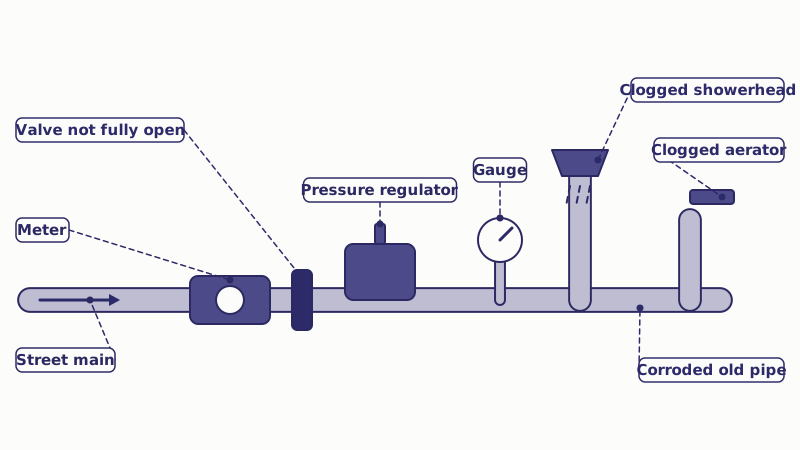
To fix low water pressure in a house, first open the main and meter valves all the way, then clean the aerators and showerheads, then check the pressure regulator, and only then suspect the pipes. The first two cost nothing and solve a surprising number of cases. If pressure is still low everywhere after that, a plumber should measure it.
This page is a spoke of our guide to a plumber for low water pressure. It follows the order a plumber would, so you do the cheap checks before paying for the dear ones.
How to fix low water pressure in a house?
Start with a gauge reading, then open every valve fully, clean the fixture screens, and test again. An inexpensive gauge that screws onto an outdoor hose bib shows whether you really have low pressure. Healthy home pressure is 50 to 70 psi, and a reading under about 40 psi is low.
Then work through this list:
- Check whether it is one fixture or the whole house. One weak tap is a fixture problem. All taps weak is a supply problem.
- Open the main valve fully. A lever handle is open when it lies in line with the pipe. A wheel handle opens by turning counterclockwise until it stops.
- Check the meter valve if you can reach it, and see that it is fully open. Leave the city's side of the meter to LADWP.
- Clean aerators and showerheads. Unscrew them, rinse out grit and soak them in white vinegar. LADWP says minerals in heated water can clog showerhead and faucet screens.
- Look for a leak. With all taps off, watch the water meter. If the dial moves, water is going somewhere.
- Check the regulator and its strainer. A clogged strainer in front of the regulator starves the house.
- Call a plumber if none of this restores the pressure.
The reasons behind the symptom are in why is my water pressure low.
How do you increase water pressure?
You increase it by removing whatever is restricting the flow, and only then by raising the regulator setting within its limit. Pressure cannot be added at the tap. The California Plumbing Code caps static pressure at 80 psi, and LADWP says regulators are normally set between 50 and 70 psi.
Ways that work, in order of cost:
- Open the valves and clean the screens. Free.
- Raise the regulator a little if it is set low, say below 50 psi, and watch the gauge.
- Replace a failed regulator. About $200 to $700 by the Angi and HomeAdvisor guides.
- Replace corroded supply pipes. Older Los Angeles homes with galvanized steel can lose a great deal of flow to scale inside the pipe. See galvanized pipe replacement.
- A booster pump. A pump helps in the rare case where the supply is weak at the street, but it does not fix a restriction inside the house, and it can overstress old pipes. A plumber should size it. Get the supply measured first.
Do not push pressure above 80 psi. High pressure damages hoses, valves and appliances, and it is a common cause of a banging pipe. See water hammer sounds.
Hillside homes have a built-in handicap. Pressure drops about 1 psi for every 2.31 feet of rise above the main, so a house high on a slope starts lower. A well-set regulator and clean pipes get you what the street can give, and the elevation does the rest.
How do you adjust a PRV?
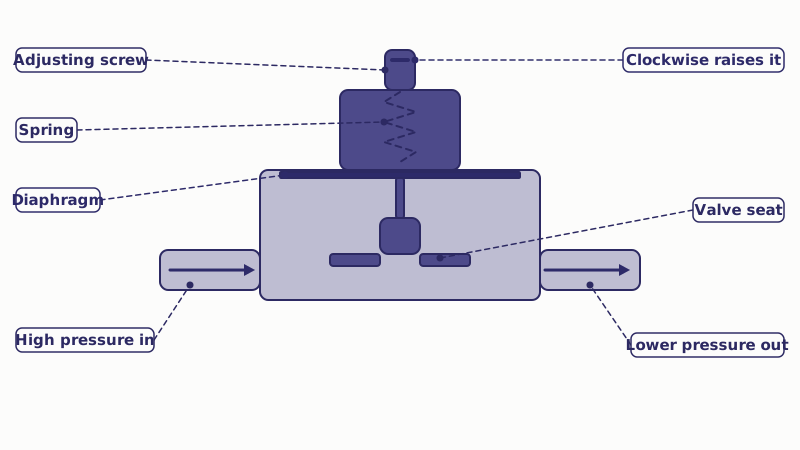
A pressure-reducing valve, the PRV, is adjusted with a screw or bolt on its top. Fit a gauge to a hose bib, loosen the lock nut, turn the screw clockwise to raise pressure or counterclockwise to lower it, a quarter turn at a time, and read the gauge each time. Tighten the lock nut when it settles between 50 and 70 psi.
Practical points:
- Leave a tap running briefly after each adjustment, then close it and read the gauge. Pressure reads high on a gauge when no water is flowing, and that static number is what the code limit refers to.
- Wait a minute between turns. The valve takes a moment to settle.
- Keep the final number at or below 80. Many plumbers aim for about 55 to 65.
- If the screw makes no difference, the valve has failed or its strainer is blocked.
Some regulators have no screw. A sealed or non-adjustable model is replaced, not adjusted. A plumber can say which type you have from the model number. To see where a regulator sits and what it does, see the water pressure regulator guide.
If you are not sure, do not guess. A wrong turn on an old regulator can send full street pressure into the house.
How can I adjust my water pressure regulator without a gauge?
You cannot do it accurately without a gauge, because feel is a poor guide to psi. If you must adjust it, change the screw a quarter turn and judge the shower and a running tap, but this risks pressure above 80 psi. A hose bib gauge is cheap and it makes the job safe.
Why it matters: your hands cannot tell 60 psi from 90. High pressure feels strong, and the damage shows up months later as a failed washing machine hose or a leaking toilet valve. So buy the gauge, or ask a plumber to set it and note the reading.
If you only want to compare, an old trick is the bucket test: time how long a tap takes to fill a one-gallon bucket before and after. It shows a change in flow but not the number, and it is no substitute for a gauge.
What causes sudden low pressure in a house?
A sudden drop is usually a closed or half-closed valve, a failed regulator, a leak, or work on the street main. Check whether neighbors have the same problem, then check your own valves and the meter. If the drop came right after plumbing work, a valve left partly closed is the first suspect.
Questions to ask yourself:
- Did anyone work on the plumbing or the water heater recently?
- Is the water meter moving with all taps off? If yes, you have a leak.
- Are neighbors affected? If the whole street is weak, call LADWP.
- Is it only the hot side? The water heater's valve or sediment may be the cause. See why you have no hot water.
LADWP also warns that when water is turned back on after a shutoff, turbulence can dislodge mineral deposits from pipes and clog screens. If pressure fell after a street shutoff, clean the aerators first.
How do I fix low water pressure in just the bathroom?
If only the bathroom is weak, clean the faucet aerator and the showerhead, check the hot and cold stop valves under the sink, and test the shower cartridge. If every other room is fine, the problem is local to that bathroom's fixtures and valves, not the house supply.
For the shower, see low water pressure at the shower head and, if you want to replace the head, our guide to the best showerhead for low pressure. For a sink, see bathroom sink low water pressure.
When should I call a plumber, and who do I call?
Call a plumber if pressure is low at every tap after you have checked the valves and screens, if it fell suddenly, if the meter moves with taps off, or if the regulator will not hold a setting. Call LADWP if neighbors are affected, since the problem is on the utility's side of the meter.
A plumber measures pressure at several points, replaces a failed regulator or valve, and tells you if the pipes need replacement. The job is priced in our guide to a shut-off valve cost for valves and regulators. To arrange a visit, use the quote page.
Common questions
How long does a plumber take to fix low water pressure?
A valve or regulator job is usually one to two hours once the plumber has measured the pressure. A hidden leak can take longer to find, and a repipe takes days. Ask for an estimate after the plumber has seen the pipes and read the gauge.
What should I ask before I hire someone to fix low water pressure?
Ask them to measure static pressure before and after, to name the fault, and to put the price in writing. Ask whether a regulator, strainer or expansion tank is included, and whether a permit applies. A quote that names the cause is worth more than a low flat price.
Does someone need to be at the property?
Yes, or someone you trust. The plumber needs access to the main valve, the regulator, a hose bib and the meter, and the water goes off for a while during any repair. Make sure gates, garage doors and crawl space hatches are unlocked and clear before the visit.
Can a water softener or filter cause low pressure?
Yes. A clogged filter cartridge or a softener that has failed can choke the flow. If pressure fell after a filter was fitted, or the filter has not been changed for a long time, try bypassing it. A plumber can check it as part of the visit.
Will a booster pump fix my low pressure?
Only if the supply to the house is genuinely weak and the pipes are sound. A pump will not cure a clogged strainer, a closed valve or scaled pipe, and it can overstress old lines. Have the pressure measured at the meter and in the house first.