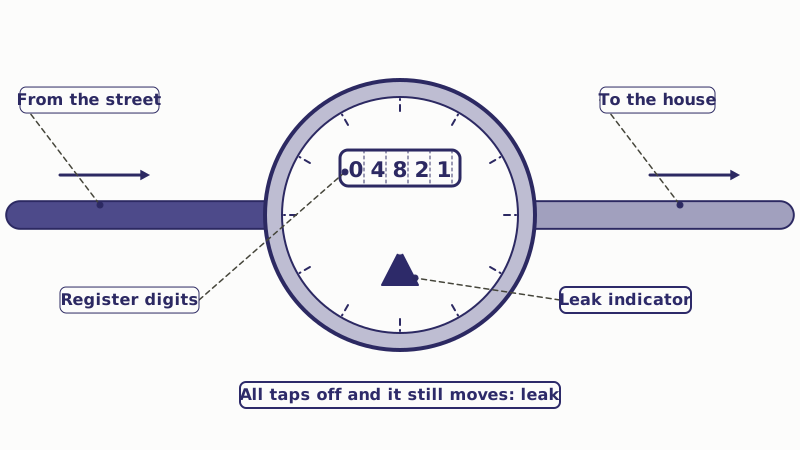
The usual reasons for a high water bill are a leak you cannot see, a running toilet, irrigation, more people at home, or a bill covering more days than normal. Check your meter with all water off: if the leak gauge moves, water is escaping. EPA says the average home loses more than 9,300 gallons a year to leaks. The plumber home page lists the jobs we arrange if you find one.
Why is my water bill so high this month?
Start with the bill itself. LADWP lists increased usage, seasonal use, a misread or estimated meter, a bill covering more than one billing period, and an unpaid previous balance as reasons a bill jumps. If none of those fit, the cause is probably a leak or irrigation, and the meter will show which.
Work through it in order:
- Compare the billing dates and days to last month's. More days means more water.
- Look for the word "estimated" or an odd meter reading.
- Think about what changed: guests, a new baby, a filled pool, a new lawn, a hose left on.
- Log in to your LADWP account and look at your usage chart. LADWP's My Water Insights is free for single-family accounts, shows usage history and sends leak alerts.
- Do the meter test below.
A spike with no change in habits is a leak until proven otherwise.
How do I check the water meter for a hidden leak?
Turn off every tap, appliance and sprinkler, then watch the leak detection gauge on your water meter. LADWP says that if the gauge moves with all water off, you have a leak. EPA suggests a second method: note the reading, wait two hours with no water use, and check again.
The meter is in a box near the curb, usually with a lid you can lift with a flat tool. Take a photo of the dial before you open anything else. If the gauge spins, the leak is somewhere between the meter and the fixtures. Close the main valve at your house and look at the gauge again. If it stops, the leak is inside the house. If it keeps moving, it is in the underground line between the meter and the house, which is yours to repair.
Underground leaks are the "no visible leak" case. Signs include a wet patch on a lawn, a damp spot near the foundation, or a warm patch on a slab floor. A plumber can find it with listening and detection equipment. Prices are on plumber leak detection cost.
Can a running toilet cause a high water bill?
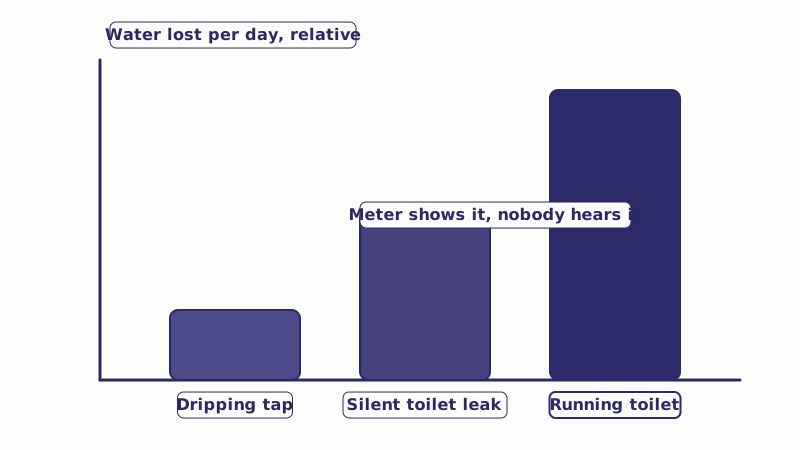
Yes, it is the most common cause of a silent leak. A worn flapper lets water seep from the tank into the bowl, so the fill valve keeps topping up. EPA says a worn flapper can silently leak thousands of gallons a year. You may hear nothing at all.
Test it with the food coloring check LADWP and EPA both describe. Put a few drops of food coloring in the tank, wait about 10 minutes without flushing, and look in the bowl. Colored water means a leak. Flush right away so the dye does not stain the tank.
A flapper or fill valve is a cheap part, and many owners replace them in under an hour. See how to repair a toilet that keeps running and toilet flapper repair. If the toilet keeps running after you change the part, the valve seat or the whole fill assembly may have failed, and a plumber can fix it. The cost of a replacement is on replacing a toilet.
Can a leaky faucet raise my water bill?
Yes, but less than a toilet or a hidden pipe. EPA says a faucet dripping about once a second can waste more than 3,000 gallons a year, and a showerhead leaking at ten drips a minute wastes over 500. That is real water, but usually a smaller part of a large jump.
Fix drips early. A dripping faucet is often a worn washer, cartridge or O-ring, and the repair is low cost. If water also appears under the sink, check the supply lines and the shutoff valve there, since a seeping valve can leak without a drip at the spout. See how to fix a leaky faucet for the steps. A drip, a slow toilet leak and a pinhole can all happen together, and each adds to the bill.
Can a water softener cause a high water bill?
It can, when it malfunctions. A softener uses water to flush and regenerate, and if the control valve sticks, it can send water to the drain continuously. You may hear it running or see a steady flow at the drain line. A normal softener adds some water use, not a large jump.
Check by watching the drain line after a regeneration should have ended. If water keeps flowing, switch it to bypass and call a plumber or the softener's maker. Hard water is common in Los Angeles. LADWP reports average hardness of about 8.6 grains per gallon in the San Fernando Valley and western Los Angeles, about 9.8 in Silver Lake, downtown and South Los Angeles, and about 16.3 in eastern Los Angeles and the Harbor, so softeners are common. See water softener installation for how they connect.
Why is my water bill high in winter?
Winter bills rise for reasons that are easy to miss: sprinklers still running on a summer schedule, guests at the holidays, a leak that no longer hides among summer use, or a toilet that has been running for weeks. Compare this winter's usage to last winter's, not to summer's.
EPA offers a rule of thumb: in a cold month, a family of four using more than 12,000 gallons a month may have a serious leak. Los Angeles winters are mild, so irrigation and leaks are the bigger factors, and an automatic controller may need adjusting after rain. Check the timer, and check for a stuck valve at the irrigation line. The LADWP leak page also says to look at irrigation for visible leaks and for unexpected bill spikes.
How do I get my LADWP bill reviewed or adjusted?
LADWP says its Customer Bill of Rights covers automatic review of bills over three times your average historic use for the same period. If the cause was an inaccurate meter reading, you get a corrected bill and a $25 credit. For leaks, LADWP says it does not repair private property leaks but may adjust the bill after an underground leak is repaired.
The Field Investigations Unit decides adjustments, so keep the plumber's invoice and photos of the repair. Ask LADWP for a meter accuracy test only after you have ruled out leaks and irrigation. If you have to fix a leak first, do it quickly and write down the date, since the adjustment depends on the repair record.
If you live outside Los Angeles, such as in Fairfax, High Point or Yorkshire, your utility's rules differ, though the meter test and the toilet test work anywhere. This site covers the City of Los Angeles.
What does it cost to find and fix the leak?
Published Los Angeles guides put plumbers at about $100 to $200 an hour plus a call-out fee, and a typical repair at a few hundred dollars. A toilet or faucet fix is toward the low end. A leaking pipe, with the damage, runs about $500 to $4,000 in guides. Leak detection is priced separately.
A pressure problem can also raise water use or break fittings, so ask the plumber to check static pressure. See water pressure regulator for the details. Maintenance such as replacing old supply hoses, exercising shutoff valves and fixing drips early keeps the next bill normal. See plumber cost for price context, then request a written quote on our quote page. How a job runs explains what happens next.
When should I call a plumber for a high water bill?
Call when the meter gauge moves with everything off, when you find a wet spot you cannot trace, when pressure drops suddenly, or when a fix does not stop the running. Call at once if water is flowing through a ceiling or wall: shut off the main valve first.
Family-owned or part of a large company, a plumber can isolate each line, test the pressure, and trace the leak with equipment, and a failure of the line to the meter is one they see often. For an underground leak in the line to the meter, the work often needs a permit, and California requires a licensed contractor for permitted work. Check the license on the CSLB site and get the price in writing. If you smell gas at any point, leave the building and call SoCalGas at 1-800-427-2200 from outside.
Common questions
How long does it take to find a water leak?
The meter test takes about 30 minutes to two hours, and the toilet dye test about 10 minutes. Finding a hidden leak in a pipe can take a plumber an hour or two with detection equipment. Repair time depends on access, from an hour for an exposed pipe to a day or more for a slab or buried line.
What should I ask before I hire a plumber to find a leak?
Ask how they will find it and what the method costs, whether the call-out fee is credited, and whether the price includes repair. Ask for the license number and a written quote. Ask them to show you the failed part, and keep the invoice, since LADWP may want it for a bill adjustment.
Does someone need to be at the property?
Yes, at least when the work begins. The plumber needs access to the meter, the main valve and the rooms, and you should see where the problem is. If the leak is outdoors, be reachable by phone. Photograph the meter dial before the visit so there is a record.
Why is my water bill high but there is no visible leak?
Leaks hide: a toilet flapper, a pipe under a slab, an underground line, or a failed irrigation valve. Do the meter test and the dye test, check irrigation, and look at your usage chart for the date the jump started. If the gauge moves with water off, call a plumber for leak detection.
Is a high water bill my fault if LADWP misread the meter?
Not if the meter was misread. LADWP lists a misread or estimated meter as a cause of high bills, and bills over three times your average for the period are reviewed automatically under its Customer Bill of Rights. Photograph your meter and compare it to the bill. If they differ, contact LADWP and ask for a corrected bill.