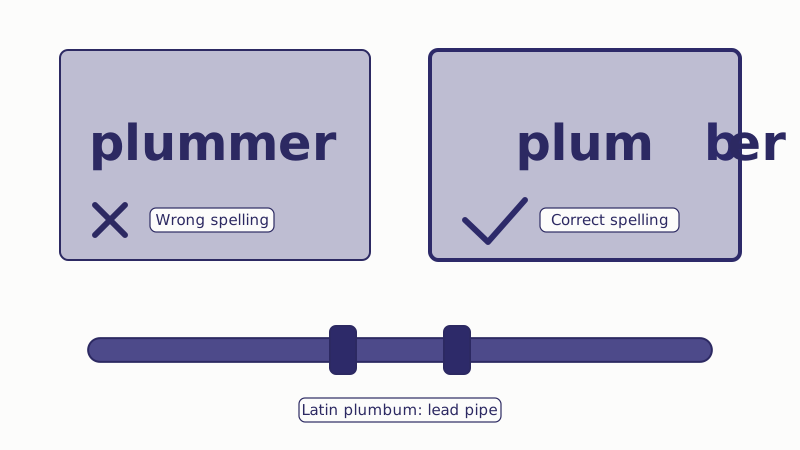
It is plumber, spelled with a b, even though you never say it. "Plummer" is a misspelling of the trade, though it exists as a surname. Searching for the wrong spelling still finds the right help, and a plumber is the person who installs and maintains the pipes that bring water in, take waste out and, in many cases, run gas. In Los Angeles a plumber costs about $100 to $200 an hour in published guides. The plumber home page shows what we arrange.
Is it plummer or plumber?
It is plumber. The b is silent in speech but stays in the spelling because the word comes from the Latin for lead, plumbum. Romans used lead for pipes and roof gutters, so people who worked with lead became plumbers. "Plummer" is a common typo, and a plain surname for some families.
The same root gives us "plumb," as in a plumb line, a weight on a string that checks whether something is vertical. That is why plumbers talk about pipes running plumb and level. It also explains the chemical symbol for lead, Pb. None of it matters for hiring, but if a business card or van says "plummer," read the license number on the quote carefully. In California, the license classification for plumbing is C-36.
What does a plumber actually do?
A plumber installs, repairs and maintains systems that carry drinking water, hot water, waste and often gas. Day to day that means unclogging drains, fixing leaks, replacing fixtures and water heaters, and running new pipe. The work is regulated, and in California a plumbing contractor needs a CSLB license.
The work divides into two broad kinds. Service plumbing is fixing, replacing and upgrading what already exists in an occupied building. New-construction plumbing is putting systems into a building that is being built, working from plans. Remodel work sits between them, in walls and floors that already exist. A plumber might do all three, but many specialize, and the quote should say which kind of work you are getting. For the different jobs we arrange, see plumber service.
What is the difference between service plumbing and new construction plumbing?
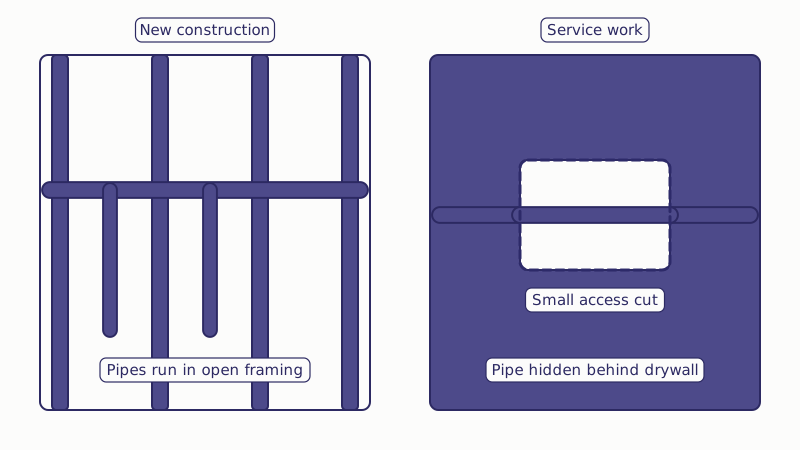
Service plumbing solves a problem in a lived-in home: the clog, the leak, the dead water heater, the failing valve. New construction plumbing installs a full system from the ground up in three stages: underground rough-in, above-ground rough-in before walls close, then finish work such as faucets and toilets.
For a homeowner, the practical differences are these:
- Pricing. Service work is priced by the job or the hour. New construction is priced from plans, often per fixture or square foot. Guides put new-construction plumbing at about $4 to $8 per square foot.
- Inspections. New construction and remodel work pass city inspections before walls close. Many service jobs, like a faucet swap, need none. A water heater or repipe needs a permit.
- Access. New construction has open framing. Service plumbers work around finished walls.
- Speed. A service visit is often a few hours. A new build's plumbing spans weeks.
If you are adding a bathroom or a unit, you need the second kind. Read about new construction plumbing and plumbing for a bathroom remodel. If your house has a problem right now, you need service work, and we can arrange it.
What does a plumber cost?
Published Los Angeles guides put plumbers at about $100 to $200 an hour, a call-out fee of roughly $75 to $250, and most repairs at a few hundred dollars. Emergency and after-hours work runs 1.5 to 3 times the standard rate. These figures are a guide, and your written quote is the real price.
What changes the price: the kind of work, the access, the age of the pipe, the need for a permit, and the time of day. New construction is priced from plans. A failure that has spread, such as a leak that has soaked a wall, adds repair work. For the full breakdown see plumber cost and how much a plumber costs per hour.
California rules protect you here. A written contract is required for home improvement work over $500, and the down payment is capped at $1,000 or 10 percent of the contract price, whichever is less. Work that needs a permit must be done by a licensed contractor, whatever the price. Check the license number on the CSLB website. A family-owned shop and a large company are both fine if the license and the written quote check out.
What is plumbing in an attic or crawlspace like?
Plumbers work in attics and crawlspaces constantly, and both are tight, hot or damp, and hard on pipe. Crawlspaces under raised Los Angeles foundations hold supply and drain lines, shutoff valves and sometimes the water heater. Attics hold vent pipe and, in some two-story homes, supply and drain runs. Access shapes the labor cost.
Things that matter in each space:
- Crawlspace. Moisture, tight clearance, pests and standing water. Pipe sags, hangers fail and joints corrode. A plumber can often repair or replace pipe here without opening walls, which is why access makes repair cheaper. Stay out if there is standing water near wiring.
- Attic. Heat, loose insulation and limited footing. Vent pipes and some supply lines run here, and a leak shows up as a ceiling stain below, sometimes far from the source.
- Both. Older insulation can be a problem. The EPA says asbestos is most common in homes built before the 1970s and can be in pipe and duct insulation, that it cannot be identified by sight, and that damaged or disturbed material should be sampled and handled by an accredited professional. If you see old wrap on pipe, do not touch it, and tell the plumber before they start.
Some owners ask whether they can crawl in and fix a pipe themselves. For a small, visible repair, perhaps. For anything involving a permit, gas, or suspect insulation, no. A ceiling stain is also a clue to read: see ceiling water leak.
Signs you need a plumber, not a handyperson
You need a plumber when work involves a permit, a gas line, a water heater, the main shutoff, a sewer line or a leak inside a wall. California requires a license for work that needs a permit, and the small-job exemption, now $1,000 for unpermitted minor work, does not cover permitted plumbing.
Watch for these signs:
- Water stains on a ceiling or wall that keep growing.
- Low pressure or brown water from several taps, which may be corroded supply pipe.
- Repeated clogs, gurgling drains or sewer smell.
- A shutoff valve that will not close, or leaks when you touch it.
- A water heater that leaks, or a relief valve that drips.
- A gas smell. Leave, then call SoCalGas at 1-800-427-2200 from outside, and 911 if there is danger.
Maintenance catches many of these early. See plumber for leaks for the first steps, then request a written price on our quote page. The steps from first message to visit are on how a job runs.
Common questions
How long does a plumber take?
A simple visit such as a faucet, a fill valve or a drain clog is often an hour or two. A water heater replacement or a leak inside a wall takes longer, and a repipe or new-construction rough-in runs over several days. Ask for an estimate and a plan for when the water will be off.
What should I ask before I hire a plumber?
Ask for the CSLB license number and check it online. Ask what the quote covers, whether the call-out fee is credited, who pulls the permit if one is needed, and what the payment schedule is. Get it in writing before work starts, and ask who will actually come to your house.
Does someone need to be at the property?
Someone should be there to show the problem, point out the main valve and approve the quote. For a crawlspace or outdoor job, being reachable by phone may be enough. Clear the area around the work beforehand, since time spent moving things can be billed.
Is plumber spelled with a b?
Yes. The b is silent, but it is part of the spelling because of the Latin root plumbum, meaning lead. "Plummer" is a misspelling. If you search with it, you will usually still find plumbers, so the typo does not hurt your search.
Does a plumber do gas work and heating?
Plumbers install and repair gas piping to appliances such as water heaters, and the work needs a license and usually a permit. Forced-air furnaces fall under a different California license classification, so check the classification on the CSLB record. If you smell gas, leave the building first, then call SoCalGas.