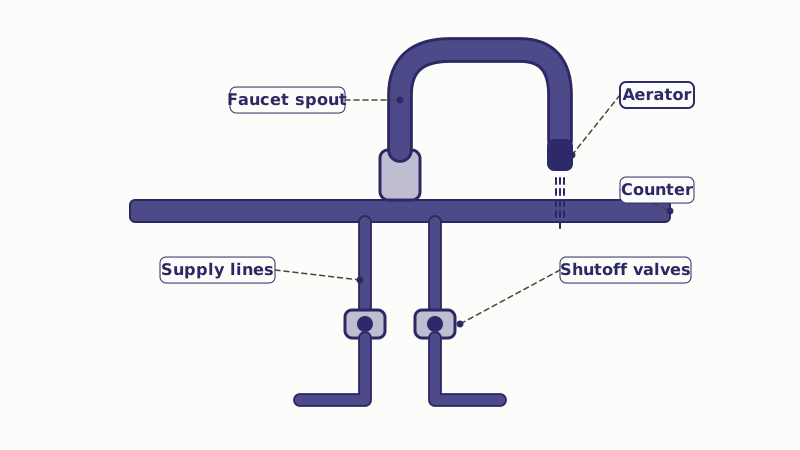
If the kitchen faucet is weak but the rest of the house runs fine, the cause is nearly always local: a clogged aerator, debris in the cartridge, a kinked or half-closed supply line, or a sprayer diverter that has stuck. You can check all four in about 20 minutes. If every fixture is weak, you have a different problem, covered in our guide to low water pressure around the whole house. This page sits under our wider coverage of faucets, sinks, showers and disposals.
Is it just the kitchen sink, or the whole house?
Run the bathroom sink, the shower and an outdoor spigot for a minute each. If they all flow normally, the problem is inside the kitchen faucet or its supply lines. If two or more are weak, the cause is upstream: a partly closed main valve, a failing pressure regulator or corroded supply pipe. Do this test first, because it decides every step that follows.
Also compare hot and cold at the kitchen sink. Weak on one side only points at that side's stop valve or supply line. Weak on both points at the aerator, spout or sprayer parts. Many Los Angeles homes from the 1920s to the 1950s still carry galvanized steel supply pipe, which narrows from the inside as mineral buildup accumulates over decades. In an older house, strong cold and weak hot can also point to scale in the pipes leaving the water heater.
Why is the water pressure low only at the kitchen faucet?
Most often the spout is choked. The aerator is the small screen at the tip of the spout, and it traps grit and mineral flakes. LADWP's FAQ puts hardness in its service area at roughly 5 to 17 grains per gallon, depending on which supply reaches your street, and says hard water leaves deposits in plumbing and in faucet aerators. Scale starts there because the openings are tiny.
Other causes, roughly from most to least common:
- A pull-out or pull-down sprayer whose diverter or check valve has stuck, so the stream splits or trickles.
- Debris in the cartridge, often after plumbing work nearby or a water main repair on your street.
- A stop valve under the sink that is only partly open or has a worn internal washer.
- A flexible supply line that is kinked, crushed behind the cabinet, or has a collapsing inner liner.
- Corroded galvanized pipe, which narrows inside and cannot be cleaned out.
How do I clean a clogged aerator?
Unscrew the aerator by hand, or wrap it in a cloth and use pliers so you do not mark the finish. Tap out loose grit, soak the screen and washer in white vinegar for an hour, brush gently, rinse and screw it back on. If the flow returns to normal, you are done. If the screen is torn or the plastic is crumbling, replace it with the same size.
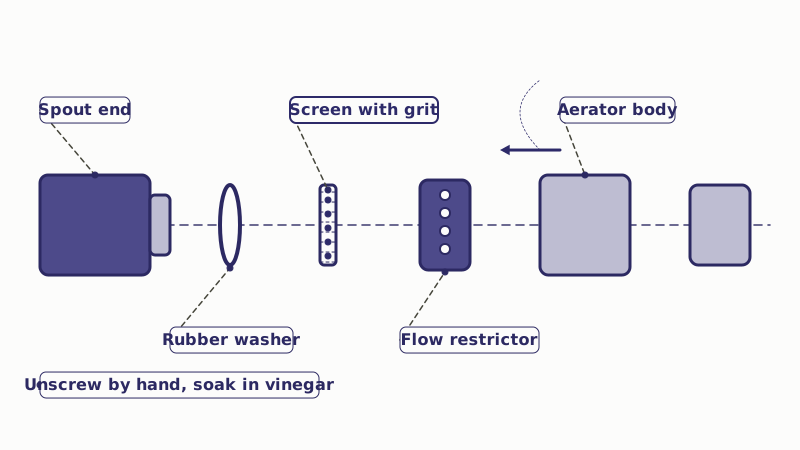
Before you refit it, run the faucet for a few seconds with the aerator off. Strong flow without it and weak flow with it proves the aerator was the problem. Weak flow even with it off means the restriction sits further back.
One caution about expectations. Under the California green building code, residential kitchen faucets are limited to 1.8 gallons per minute at 60 psi, so a new faucet or a new aerator will feel gentler than an older unrestricted fixture. Low flow by design is not a fault.
What if the aerator is clean and flow is still weak?
Close both stop valves under the sink, disconnect the supply lines from the faucet and aim each line into a bucket. Open each stop valve in turn. A strong stream from both means the supply side is fine and the fault is inside the faucet body or cartridge. A weak stream means the stop valve or the pipe behind it is restricted.
If the faucet is at fault, a single-handle model usually needs a new cartridge. Our guide to fixing a leaky kitchen sink faucet shows how a cartridge comes out. Grit that blocks a cartridge sometimes washes out when you flush the line into a bucket with the faucet detached, so try that before you buy parts.
If the stream from the stop valve is weak, replace the stop valve and the flexible supply line. Both are inexpensive parts, and many older stops are multi-turn compression valves that wear inside. If a new valve changes nothing, the restriction is in the wall, and that is a plumber's job.
Could a pressure regulator or the main supply be involved?
Yes, when more than one fixture is weak. Many Los Angeles homes, especially in hillside areas, have a pressure-reducing valve near where the water line enters the property. The California Plumbing Code calls for a regulator where static pressure in the house would otherwise exceed 80 psi, and a worn regulator can let pressure fall well below that.
You can check with a hose-bib pressure gauge, a cheap hardware store item. Screw it onto an outdoor spigot with every fixture off. Roughly 40 to 80 psi is the normal band. Under about 40, sink and shower flow feels weak. A reading far below that in a house that used to be fine points at the regulator or the main valve, and a plumber should look at it.
Our page on the water pressure regulator covers testing and replacement, and the guide on why water pressure drops in a home covers causes that reach beyond one sink.
Does hard water make kitchen faucet pressure worse over time?
It can. Scale grows inside aerators, cartridges and spray heads, and it grows faster where water is heated, so hot flow often drops first. LADWP's FAQ says hard water leaves mineral deposits in plumbing and water heaters, and that even its hardest water does not need softening to be safe or usable. Softening is a comfort and maintenance choice.
If scale is the pattern, soak the aerator in vinegar every few months. If you start using a softener, note LADWP's warning that softening can loosen old deposits, which then clog aerators, showerheads and appliance inlet screens. Check the aerator a week after the switch. For a full cleaning method, see our page on removing hard water scale.
When should I call a plumber for low pressure at the kitchen sink?
Call one when cleaning the aerator and flushing the lines does not help, when a stop valve is stuck or leaking, or when more than one fixture is weak. Galvanized supply pipe that has narrowed inside cannot be cleaned and usually means replacing sections or repiping. A plumber can measure pressure and flow at several points and find where it is being lost.
Do not pour drain cleaner or any chemical into a supply fixture. It does nothing for a pressure problem and can damage the finish and seals. If you see water stains under the sink or smell damp wood, treat it as a leak first, shut the stop valves and read our page on repairing a leaking pipe under the sink.
When you want someone to look at it, ask for a written quote and we'll arrange a local plumber to come to you.
Common questions
Why is my kitchen sink water pressure low but the bathroom is fine?
Something is restricting that one faucet or its lines. The usual suspects are a scaled aerator, debris in the cartridge, a partly closed stop valve or a kinked supply line. Whole-house causes such as the main valve or a regulator would weaken the bathroom as well, so the fact that it runs fine there narrows the search to the kitchen.
Why is only the hot water weak at my kitchen sink?
Check the hot stop valve and supply line first. If both are clear, scale in the pipes leaving the water heater is a common cause in older Los Angeles houses, because heat speeds up mineral buildup. If hot is weak at every fixture, the water heater's shutoff valve or outlet piping may be partly blocked, and a plumber should check it.
Can a new faucet fix low water pressure?
Only if the old faucet was the restriction. A new faucet does not raise pressure, and because California limits kitchen faucets to 1.8 gallons per minute at 60 psi, a new one may feel gentler than an old one. If other fixtures are also weak, replacing the kitchen faucet changes nothing.
How much does a plumber charge to fix low pressure at one faucet?
A simple fix, such as replacing a stop valve and supply line, is a short visit and usually priced close to a standard service call. Costs rise if pipe inside the wall must be replaced. Our guide to plumber service call costs explains what to expect, and you should get a written quote before any work starts.
Is low pressure at the sink an emergency?
Not on its own. If you also see wet cabinets, a musty smell, a hissing sound or a rising water bill, shut the stop valves and call a plumber the same day, because a leak may be stealing the flow. Otherwise, work through the checks above and book a visit when they fail.