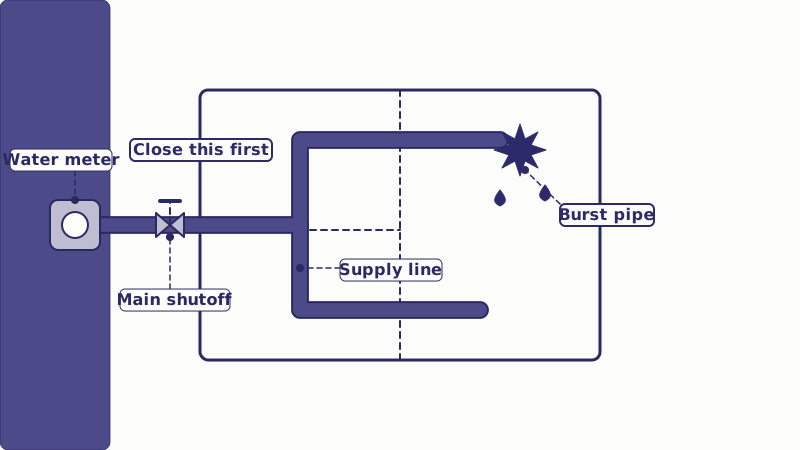
If a pipe has burst, shut off the water at your main valve, then open a faucet at the lowest point of the house to drain what is left in the line. Water is the damage here, so every minute counts. Once the flow stops, you have time to photograph, dry and call someone. Our leaks and burst pipes hub covers the neighboring problems, and the home page shows how we arrange a plumber visit.
What do I do first when a water pipe bursts?
Shut off the water at the main valve for the house, then open the lowest faucet to drain the line. If the main will not turn, shut the valve at the meter or call LADWP. Keep clear of any water near outlets, the electrical panel or light fixtures. Turn the power off at the breaker only if you can reach the panel while standing on dry ground.
A sensible order for the first ten minutes:
- Stop the water at the main. On many Los Angeles homes the valve sits where the supply line enters the house, often near the front hose bib, in the garage or at a basement wall.
- Open the lowest tap, usually an outside spigot or the tub, so the pipes empty.
- Check the water heater. If water is pouring from a hot line, shut its power or gas control so it does not run dry and overheat.
- Photograph the damage and the burst section before you move anything.
- Move rugs, electronics and paper out of the wet zone.
Do not walk into standing water if you think it touches a live outlet or an appliance. Stay out and call a plumber, an electrician or 911 if anyone is at risk.
How do I find the main water shutoff in an older Los Angeles house?
Look where the water line enters the building: a wheel handle or lever valve near the front wall, a garage wall or the laundry area. Houses built in the 1920s to the 1950s often have a gate valve with a round wheel that can seize with age. If it will not budge, do not force it. Use the shutoff at the meter, or ask LADWP for help.
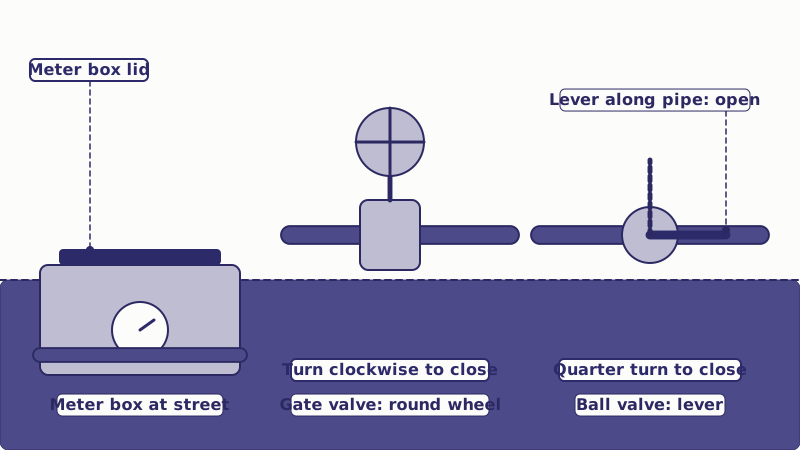
The LADWP meter sits in a box near the curb. LADWP says to report an active leak by phone at 800-342-5397, or in person at a Customer Service Center, to get help turning water off for an emergency repair. That helps with the shutoff only. LADWP does not repair leaks on private property.
A tip worth doing before anything breaks: find the valve now, label it, and check that it turns a quarter turn. A stuck main valve is one of the most common reasons a small burst turns into a flooded floor. If the valve is stuck or leaks around the handle, a plumber can replace it, and the plumber cost page shows what visits like that tend to involve.
What should I do about water damage after a burst pipe?
Dry the area within 24 to 48 hours. The US EPA says that is the window in which mold usually does not take hold on wet materials. Remove standing water, run fans and a dehumidifier, lift soaked rugs, and open wall cavities if water got in. Porous materials such as ceiling tile, drywall and insulation that stay wet beyond 48 hours often have to be replaced.
Take photos and video of everything before cleaning up, and keep damaged items until your insurer has seen them if you plan to claim. Our page on whether insurance covers a burst pipe covers what to expect.
The EPA's rule of thumb on size is that a patch of mold under about 10 square feet is often a homeowner job, and larger areas call for a contractor with mold cleanup experience. Do not paint or caulk over mold. If the water came from a sewer or a drain rather than a clean supply line, the EPA says to call a professional.
What if the pipe burst in a wall, a ceiling or an apartment?
A pipe bursting inside a wall or ceiling still needs the main shutoff first. In a multi-unit building, shut off your own unit's valve if you have one, or call the property manager or owner right away so the building's riser can be isolated. Tell them in writing as well, with photos and times, so there is a record.
Signs of a burst pipe behind a surface include a sagging or bulging ceiling, wet drywall, a hissing or running sound with all taps closed, and a meter that keeps moving. To confirm, shut every tap, then watch the leak indicator on the LADWP meter. If it moves while all water is off, water is escaping somewhere. Our guide on how to know if a pipe burst goes into the checks in more detail.
A ceiling that is sagging with water can fall. Stay out from under it and keep people and pets away. Our page on a ceiling water leak covers that case.
What if the burst is outside the house?
Shut the main valve, then look for a wet patch, a lawn that is suddenly soggy, water at the curb or a meter that spins with everything off. A burst on the supply line between the meter and the house is on your side of the meter and is your repair. LADWP does not repair leaks on private property.
After an underground leak is fixed, LADWP says you may qualify for a billing adjustment. The request must come within 12 months of the leak, it takes copies of your repair receipts, and LADWP honors one underground leak request in a 24-month period. Leaking sprinklers, water heaters, faucets, toilets and pool equipment do not qualify. Keep every receipt and photo.
Digging in a yard raises other questions: where gas and electric lines run, whether a permit is needed, and whether the new pipe matches the old. Under the Los Angeles code, replacing a defective metallic water service line with the same size, quality and conductivity is exempt from the permit, but you cannot swap it for plastic under that exemption. Ask the plumber to confirm what applies to your job.
Why do pipes burst in Los Angeles when it rarely freezes?
In most of Los Angeles, freezing is not the usual cause. Pipes burst when old metal wears through at a thin spot, a fitting fails, pressure is too high, or the ground moves and strains a line. Galvanized steel, which rusts from the inside, and copper with pitting both fail in this way. Houses from the 1920s to the 1950s are the likeliest to have such lines.
Water pressure matters as well. The California Plumbing Code calls for a pressure regulator where static pressure is above 80 psi. Street pressure varies with elevation and distance from the supply, and a failing regulator lets full street pressure through. A plumber can fit a gauge to a hose bib and read the number in a minute. See our what causes a pipe to burst page for the full list.
Do not assume the break was a one-off. If one section failed from age, others may follow, and a plumber can advise whether a repair or a bigger replacement makes sense. Repiping a house is the larger option when failures keep happening.
When should I call a plumber for a burst pipe?
Call a plumber as soon as the water is off, because a burst pipe needs cutting out and replacing, not patching. If you cannot stop the flow, if the burst is in a wall, slab or under the house, or if water touched electrical gear, call right away. We'll arrange a local plumber to come to you through the quote page.
Typical jobs after a burst are cutting out the failed section and fitting new pipe, testing the line under pressure, and checking the rest of the run for weak spots. If the break was from age, the plumber may suggest replacing more of the line while the wall is open. Ask for a written quote that lists the section being replaced, the pipe material, any wall repair and the permit, if one is needed.
For urgent calls, see the emergency plumber for a burst pipe page.
Common questions
How long does a burst water pipe take to fix?
Stopping the water takes minutes. A straightforward repair on an exposed pipe is often done in a few hours once the plumber is on site. A burst inside a wall, ceiling or slab takes longer because the plumber has to open the surface, replace the pipe, test it, and then wait for drywall, paint or flooring crews. Drying the area can take days.
What should I ask before I hire someone for burst water pipe repair?
Before you agree to a price, look up the CSLB record at cslb.ca.gov and confirm the name matches the contract. Then ask three things: does the price include opening and closing the wall, is the line pressure tested afterward, and will the rest of the run be inspected. Get it in writing. The legal cap on a deposit is $1,000 or 10 percent, whichever is lower.
Does someone need to be at the property?
Yes, or send an adult you trust. The plumber needs to reach the main valve, the burst and the rooms around it, and you may have to approve extra work once the pipe is open. Renters should warn the landlord or manager first, since some buildings require their permission for any work on the plumbing.
Is a pipe bursting machine the same thing as a burst pipe?
No. Pipe bursting is a trenchless way of replacing an old underground pipe: a tool is pulled through the old line, breaks it apart and pulls a new pipe in behind it. It is something a contractor does on purpose, usually to a sewer or water service line, and is a different matter from a pipe that fails on its own.
Is a copper pipe burst different from other pipe bursts?
The first steps are identical: stop the water and drain the line. A copper line often fails from pitting or from a failed joint, so a plumber will look at nearby copper for signs of the same wear. Our page on how to repair a copper pipe leak covers smaller failures that are not a full burst.