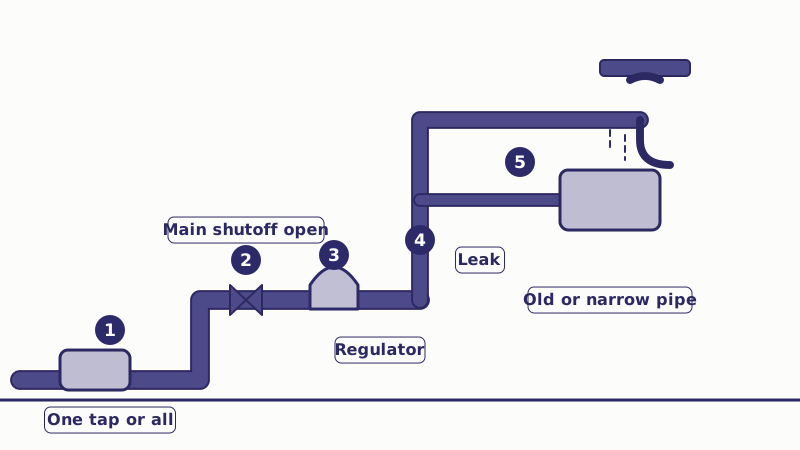
Water pressure is low when something between the street and your tap is restricting the flow, or when the street itself delivers little. The usual culprits are a valve that is not fully open, a failed regulator, scale inside old pipes, a hidden leak, a clogged fixture screen, or a house sitting high on a hill. Which one it is depends on where the pressure drops.
This page helps you narrow it down. It is a spoke of our guide to a plumber for low water pressure, and the next step, once you know the cause, is in how to fix low water pressure in a house.
Before you start: is it one tap or the whole house?
Run every tap and note which are weak. One weak tap means a clogged aerator, a worn cartridge or a half-closed stop valve at that fixture. Weak hot water only means the water heater side. Weak everywhere means the problem is in the supply: the main valve, the regulator, the service pipe or the street.
That split saves money, because the fixes are very different. A fixture fault is a small repair. A supply fault needs a gauge, and sometimes a plumber.
If you have a gauge, screw it onto an outdoor hose bib and read it with the water on. Healthy pressure at a home is about 50 to 70 psi. LADWP says residential regulators are typically set in that band. A reading under about 40 psi is low, and a reading above 80 is too high, because the California Plumbing Code requires a regulator above that.
What are the most common causes of low water pressure in a Los Angeles home?
The most common causes are a partly closed main or meter valve, a failing pressure regulator or clogged strainer, corroded galvanized pipe, a hidden leak, mineral scale in fixtures, and elevation. The first three are the most frequent in whole-house cases, and the last depends on where the house sits.
| Symptom | Likely cause | Who fixes it |
|---|---|---|
| Every tap weak, sudden | Valve partly closed, or the street | You, or LADWP |
| Every tap weak, gradual | Scaled pipes or a failing regulator | Plumber |
| Hot side only | Water heater valve or sediment | Plumber |
| One tap only | Aerator, cartridge or stop valve | You, or a plumber |
| Weak, and the bill is up | Hidden leak | Plumber |
| Strong at night, weak by day | Supply varies with neighborhood demand | Plumber to check the regulator |
| Banging pipes with high readings | Pressure above 80 psi | Plumber |
Each is explained below.
Could a partly closed valve be the cause?
Yes, and it is the first thing to check because it is free. A main shut-off or meter valve left a turn short after plumbing work, a water heater swap or a move-in can cut pressure to every tap. Open the valve fully: a lever handle lies in line with the pipe, and a wheel handle turns counterclockwise until it stops.
Gate valves, the wheel type common in older Los Angeles homes, can also fail inside. The handle spins but the gate no longer lifts, so the valve looks open and is not. If the valve is old and stiff, a plumber replaces it, and our page on shut-off valve replacement costs shows what that costs.
Do not force a valve that will not turn. An old stem can snap.
Could the pressure regulator be failing?
Yes. A regulator that has stuck partly closed, or whose strainer has clogged with debris, restricts the supply to the whole house. One that has failed open does the reverse and lets high pressure through. A gauge reading outside the 50 to 70 psi band, or one that swings through the day, points at it.
LADWP says new residential plumbing in the City of Los Angeles needs a regulator wherever main pressure can exceed 80 psi, that the owner installs and maintains it, and that older homes may not have one. A regulator wears out over the years, so one that is old is a likely cause of trouble. Our page on the water pressure regulator covers where it is, what it should be set at and the replacement price, about $200 to $700 by the Angi and HomeAdvisor guides.
Could old pipes be the cause?
Yes, especially in older houses. Many Los Angeles homes built from the 1920s to the 1950s have galvanized steel supply pipes, which corrode and scale inside. The opening narrows, so flow falls even though the pressure at the meter is fine. A gauge showing good pressure at the meter and poor pressure at the taps points to this.
Galvanized pipe does not recover. The lasting fix is replacement with copper or PEX, and a plumber can tell you from the pipe, its age and a flow test whether that is needed. See galvanized pipe replacement and the price guide for replacing the plumbing in an old house. A full replacement is covered on repiping a house.
Hard water adds to the problem. LADWP reports average hardness of 147 mg/L as calcium carbonate in the San Fernando Valley and western Los Angeles, 168 mg/L in the Silver Lake, downtown and South Los Angeles area, and 279 mg/L in the east and Harbor area. Scale forms in heated pipes and fixtures first. See removing hard water scale.
Could a leak or a hillside be the cause?
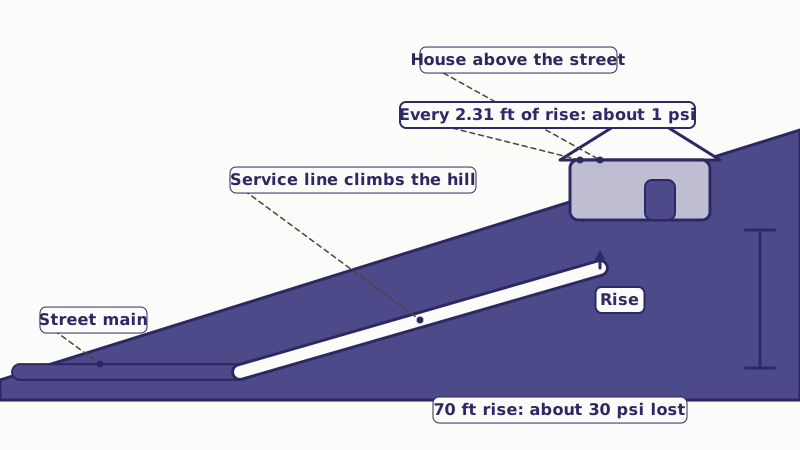
Yes to both. A leak on the supply line lets water escape before it reaches the taps, so pressure drops and the bill rises. A hillside home starts with less pressure because every 2.31 feet of rise above the main costs about 1 psi. A house 70 feet above the street loses about 30 psi to elevation alone.
To test for a leak, shut off every tap and appliance and watch the meter. If the dial or leak indicator still moves, water is escaping. Common places are under slabs, behind walls and in irrigation lines. See why your water bill is so high.
For a hillside house, you cannot change the elevation, but you can make sure the regulator is set well and the pipes are clear. LADWP can give the maximum and minimum pressure at your address, free, calculated from ground elevation, so you know what the street can deliver.
What to do next
Check the main valve and the screens, take a gauge reading, and watch the meter. Those three steps point to the cause in most cases. Then follow the matching fix in how to fix low water pressure in a house, or ask a plumber to measure and quote.
If one fixture is the problem, see low water pressure at the shower head. If you think hard water scale is involved, a whole house water softener is a longer-term option, though LADWP says even its hardest water does not need softening to be safe.
When to call a plumber
Call one if pressure is low at every tap after the valves and screens are clear, if it fell suddenly with the meter moving, if you see readings over 80 psi, or if the house has old galvanized pipe. A plumber measures at several points and gives a written quote before any work starts.
Use the quote page to describe the symptoms, the gauge readings and the age of the house. We'll arrange for a local plumber to come to you. If neighbors are affected too, contact LADWP first, since the cause is on the utility's side of the meter.
Common questions
How long does a plumber take to find the cause of low pressure?
Often under an hour, because the plumber measures at the hose bib, the main and a fixture and compares the readings. A hidden leak or a restriction in old pipe can take longer to pin down. The repair is a separate time, from an hour for a valve to days for a repipe.
What should I ask before I hire a plumber for low pressure?
Ask them to measure static pressure and show you the numbers. Ask what they think the cause is, what the fix costs, and whether the price includes a regulator or strainer. Ask for the quote in writing, since California requires a written contract for home improvement work over $500.
Does someone need to be at the property?
Yes, or someone you trust. The plumber needs access to the main valve, the meter, the regulator and a tap or hose bib to attach the gauge. The water will go off for a short time if a valve or regulator is replaced, so plan the visit around that.
Is low water pressure the same as low water flow?
Not quite. Pressure is the force of the water, and flow is the volume that comes out. A narrowed pipe can keep pressure high at rest but cut flow when a tap is open. A gauge reads static pressure, so a flow test, timing a bucket fill, helps tell the two apart.
Can low pressure damage my plumbing?
Low pressure itself rarely damages pipes, but it can stop a tankless heater from firing and make appliances run poorly. High pressure above 80 psi is the bigger risk, since it strains hoses, valves and fittings. Measure first, so you know which problem you have.