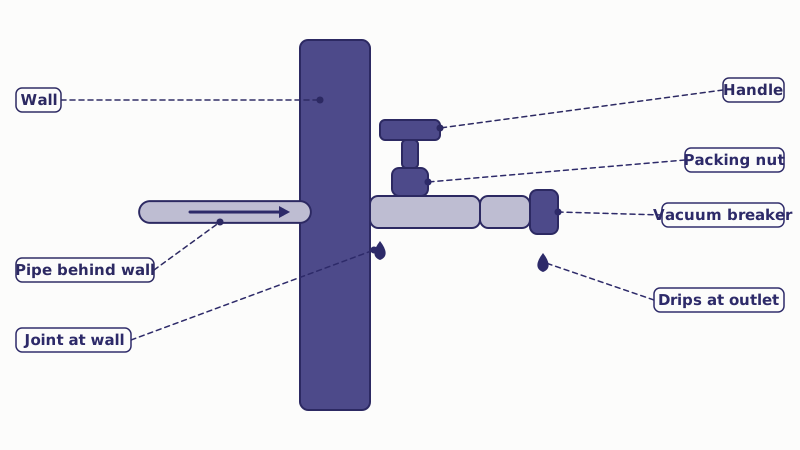
An outdoor faucet leaks from the spout, from under the handle, or from the vacuum breaker cap, and the repair is different for each. A drip from the spout when the handle is off is a worn washer or seat. Water from behind the handle is a loose packing nut. A spray from the cap at the top is a failed vacuum breaker. If water shows inside the wall, stop and call a plumber. Our hub on faucets, sinks, showers and disposals covers other fixtures.
Which part of my outdoor faucet is leaking?
Close the handle firmly and look. Drips from the spout mean the washer or seat inside the valve has worn. Water that appears under the handle and runs down the body when the faucet is open means the packing nut or packing is leaking. Water squirting from the small cap near the top when you run a hose means the vacuum breaker is releasing, which is partly normal.
Check inside, too. If the wall below the faucet is wet inside the garage or crawl space, or the drywall is stained, the leak is in the pipe behind the faucet. Frost-proof sillcocks have a long stem that runs through the wall, and a failed stem seal can leak out of sight.
How do I stop a drip from the spout?
Shut off the water to the faucet, then take the handle off and unscrew the packing nut with a wrench. Pull out the stem. The rubber washer is held by a small screw at the end, so remove the screw, pull out the old washer and replace it with one of the same size and shape. Replace the packing washer or packing string too, then reassemble and test.
Most hardware stores sell washer assortments. EPA WaterSense says worn washers and gaskets frequently cause faucet leaks, and one that drips once per second wastes more than 3,000 gallons a year. If the seat inside the valve body is rough or scored, a new washer will not seal, and the faucet itself should be replaced.
On a frost-free sillcock, the washer sits at the inner end of a long stem. You remove the stem the same way, but it can be a foot or more long. Pull it straight out, and take the whole stem to the store, because the stem is often sold as a complete kit.
How do I fix a leak around the handle?
Tighten the packing nut a quarter turn with a wrench, with the faucet on. Often that is all it takes. If the leak continues, shut off the water, take the nut off, and wrap a few turns of graphite packing string or fit a new packing washer around the stem, then retighten gently. Over-tightening makes the handle stiff and can strip the stem.
If the handle turns but nothing happens, or the leak keeps returning, the stem or the valve body is worn. Replacing a faucet is simple when it threads onto a pipe, but a sweat-soldered copper faucet needs a torch. Soldering near a stucco wall, or with other plumbing and wood framing close behind it, is a job for a plumber. Do not use a torch without fire protection and water fully drained.
What about a leaking vacuum breaker?
A vacuum breaker is the small device on top or on the side of the spigot. California requires hose connections to be protected against backflow, with a nonremovable hose bibb vacuum breaker or backflow preventer, so garden hoses cannot siphon dirty water into your drinking supply. A little water spitting from the cap while the water runs is normal. A steady stream when the faucet is closed is not.
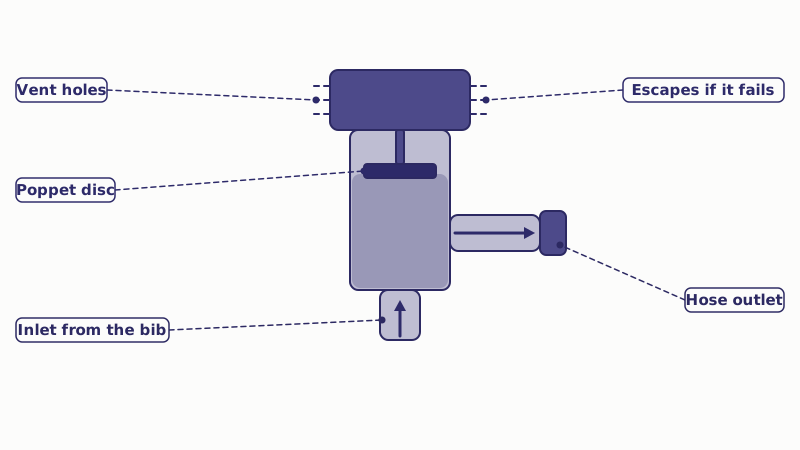
Replace a failed breaker rather than repair it. Unscrew it by hand, or with a gentle grip, and avoid using big wrenches that can strip the threads or twist the pipe inside the wall. A new one threads on and is usually finished with a break-off set screw that makes it hard to remove later. A cracked or missing breaker should not be left in place.
Check the label on the one you buy. If you want a sillcock to carry both frost protection and backflow protection, buy one that lists both, or add a breaker to a frost-free model.
Do I have to worry about freezing in Los Angeles?
Rarely. Most of Los Angeles stays above freezing, so frost damage is uncommon, and most outdoor faucets here are standard types. The risk exists in higher, inland and canyon neighborhoods during rare cold snaps. If you are in such a place, remove hoses in winter and leave the faucet open a crack on freezing nights. A frost-free sillcock slopes so the water drains out of the stem.
Exposed pipe that freezes can split, and a split pipe is a bigger repair than a faucet, so cover exposed outdoor pipe in cold areas.
When should I call a plumber?
Call a plumber when water appears inside the wall, when a sweat-soldered copper faucet needs replacing, when the stem will not budge, when a new washer and packing do not stop the leak, or when water pressure from the faucet is poor. Corroded galvanized pipe behind the faucet is common in older Los Angeles homes and cannot be fixed with a washer.
For a leak you cannot find, read our page on finding a leak behind a wall. A leaking outdoor faucet is a minor leak, but it can add to the bill, so see why a water bill gets high. To book a visit, ask for a written quote and we'll arrange a local plumber to come to you. For the method that applies to any dripping faucet, see how to fix a leaky faucet.
Common questions
Why does my outdoor faucet drip when it is turned off?
The washer or seat inside the valve has worn out, so the valve no longer seals. Hard water scale can contribute. Replace the washer, and if the seat is scored, replace the faucet. A leak at the spout that continues for days wastes a lot of water over a year.
Can I fix a leaky hose bib without shutting off the water to the house?
Some outdoor faucets have their own shutoff valve inside the house or garage. If yours has one, use it. If not, you need to close the main house valve first. Do not remove the stem under pressure, or you will get a jet of water.
How do I fix a leaking packing nut on a faucet?
Tighten the packing nut a quarter turn with the faucet on. If it still leaks, shut off the water, remove the nut and add fresh packing string or a new packing washer around the stem. Retighten until the handle turns smoothly with no leak. Do not overtighten, or the handle will bind.
How long does it take to fix a leaky outdoor faucet?
A washer or packing repair usually takes 20 to 45 minutes. Replacing the faucet itself takes longer, and a soldered replacement can run an hour or more. A stuck stem or a leak in the wall will take longer still and may need a plumber.
How much does a plumber charge to replace an outdoor faucet?
A hose bib swap is usually among the lower-cost plumbing jobs, and the price varies with access, pipe type and the faucet chosen. See faucet installation and replacement costs for a guide, and ask for a written quote before work starts.