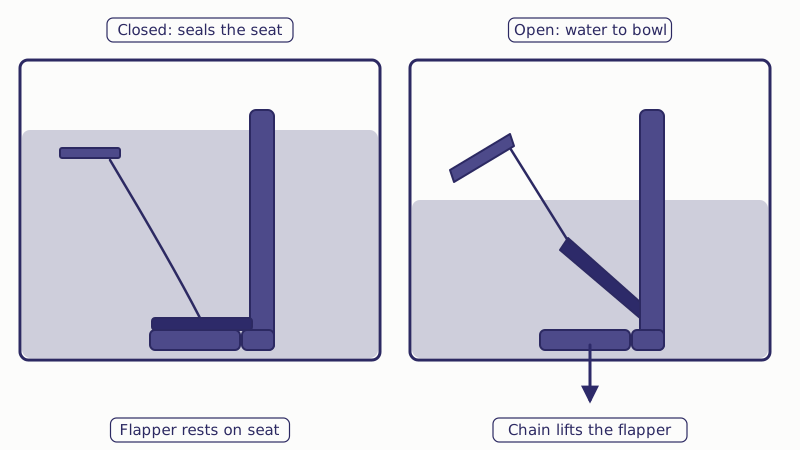
Toilet flapper repair is usually a replacement: the rubber wears, hardens or warps, stops sealing, and a new one costs a few dollars and takes ten minutes. Shut off the water, flush, unhook the old flapper, clip in a matching one and set the chain with a little slack. If you want the full list of tank parts that can fail, our toilet repair page has them.
This page covers the flapper only. If the water is running because the level is too high, the fill valve is the part to check instead.
How do you know the flapper is bad?
A bad flapper lets water seep from the tank into the bowl, so the tank slowly empties and the fill valve tops it up. You hear the toilet refill with nobody flushing, or you hear a faint trickle. The dye test confirms it: color from the tank showing up in the bowl means the flapper leaks.
EPA WaterSense describes the test: add a few drops of food coloring to the tank, do not flush, and check the bowl after about 10 minutes. Flush right afterward so the dye does not stain the tank. The same EPA material says small leaks from worn flappers can waste about 30 gallons a day, or roughly 900 gallons a month, and worn flappers are among the most common toilet leaks.
Quick look as well. Lift the flapper by hand. Is it gooey, ridged, cracked or curling at the edge? Wipe the seat it rests on, a ring around the drain hole at the bottom of the tank. Mineral build-up or a pitted seat stops a new flapper from sealing too, and you can scrub the seat gently with a non-scratch pad.
What kinds of toilet flapper are there?
The common types are the standard rubber flapper that hinges on two ears at the overflow tube, the flapper that clips around the tube as a ring, the adjustable flapper with a float to set how long it stays open, and the canister or tower valve that replaces the flapper entirely. Dual flush toilets use a different valve.
How to tell which you have:
| What you see | What you have | Notes |
|---|---|---|
| Rubber cup hinged on two small pegs at the base of the overflow tube | Standard hinged flapper | Cheapest and most common |
| Rubber disc on a ring that slips over the overflow tube | Ring-style flapper | No pegs, so it fits some oddly shaped tubes |
| Flapper with a small float or dial | Adjustable flapper | Lets you set how long it stays open |
| A tall plastic tower with a rubber seal at the bottom, no hinged flap | Canister valve | Replaced as a flush valve kit, not a flapper |
| A button on top and two flush volumes | Dual flush | Uses its own valve, so match to the model |
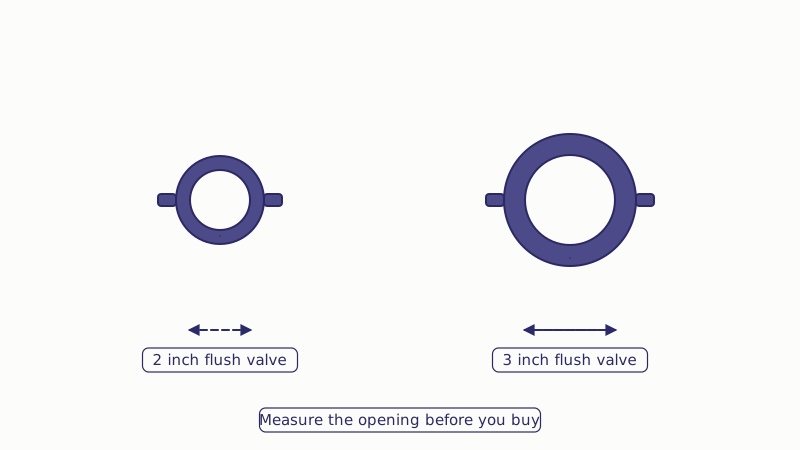
Size matters. Many toilets have a two inch flush opening, and many newer ones have a three inch opening, so a flapper that fits one will not seal the other. Measure the opening or take the old flapper to the store, and match it to the toilet's make and model. Older toilets built before the 1.6 gallon era may use a different style, and for old toilets the maker's replacement part list is the best guide. If the toilet is very old, a replacement flapper may no longer be sold. That is when replacing the whole toilet starts to make sense, as our cost guide shows.
How do you replace a toilet flapper step by step?
Close the shut off valve, flush to drain the tank, unclip the old flapper from its pegs or ring, and detach the chain from the handle arm. Clip the new flapper in the same way, attach the chain with about half an inch of slack, open the water, and test with the dye method.
In more detail:
- Water off. Turn the valve behind the toilet clockwise. Flush and hold the handle until the tank is mostly empty.
- Remove the old flapper. Slide the ears off the pegs, or lift the ring off the tube. Unhook the chain from the lever.
- Clean the seat. Wipe the ring at the flush opening with a damp cloth.
- Fit the new flapper. Same orientation as the old one. The chain attaches to the lever arm.
- Set the chain. A little slack, not tight and not long enough to tangle under the flapper. A taut chain keeps the flapper from closing. A very long one can get caught beneath it.
- Restore water and test. Let the tank refill. Flush a few times and watch the flapper drop fully each time. Then do the dye test again.
Chain trouble is a common reason a new flapper still runs. If the flapper is not closing fully because the chain is too tight or hung up on the lever, you will see the toilet keep running after a flush. Our toilet keeps running page covers the other causes, including how to fix a running toilet.
What about old-style flappers and RV toilets?
On a very old toilet, the flapper may be a rubber ball or a tank ball on a guide rod, not a hinged flapper. A hardware store can supply a modern conversion kit that swaps the old ball for a flapper, though you have to match the flush valve size. RV toilets use a different seal, and you replace that by model.
RV toilets often use a water valve with a foot pedal and a rubber blade seal, not a gravity flapper. If you own one, check the maker's parts diagram for the exact seal. Do not substitute a household flapper, since the parts are not interchangeable.
For an old house with its original toilet, a conversion kit is cheap, but a cracked tank or a rusted bolt may also be on the list, so look at the whole toilet before you buy parts. If the toilet is an older high-volume model and you remodel, California's plumbing fixture law may require replacing it anyway. See the rules in our repair toilet leak page.
What does it cost to have a plumber replace a toilet flapper?
A plumber typically charges about $60 to $150 to replace a toilet flapper, including the part, per published 2026 cost guides. The part alone is $5 to $25. The price is mostly the service call, so most plumbers prefer to do the flapper along with a fill valve or a supply line.
Where you pay more: a hard-to-find part for an older toilet, a canister conversion, or a corroded seat that needs a repair kit. Where you pay less: a handyman for a simple swap typically charges $60 to $150 for small toilet repairs, and if you replace the flapper yourself, the cost is a few dollars.
Because flappers and fill valves wear out at a similar rate, ask for both to be checked in a single visit. A combined fill valve and flapper job is often priced around $150 to $225 in published guides, which is less than two visits. If you want a price that fits your house, use the quote page. We'll arrange a local plumber, and you get a written quote before any work starts.
When should you call a plumber about a flapper?
Call a plumber when the new flapper does not stop the leak, when the flush valve seat is pitted, when the shut off valve will not close, or when the tank is cracked. In those cases the problem is bigger than the rubber seal. The same goes if you have several toilets to check.
A local plumber can replace the flush valve, the whole assembly that includes the seat and overflow tube, which is the permanent fix for a worn seat. See repair a toilet overflow tube for how that part works. For the whole service, City of Angels Plumbing lists what we arrange across Los Angeles.
Common questions
How long does a toilet flapper repair take?
For most people, ten to twenty minutes the first time, including draining the tank. A plumber does it faster, and usually as part of a bigger visit. If the flush valve seat needs replacing, the job takes longer because the tank may have to come off the bowl.
What should I ask before I hire someone for toilet flapper repair?
Ask what the quote includes: the flapper, the chain, a check of the fill valve and the shut off valve. Ask about the service call fee, and whether a flat price covers everything in the tank. It is also fair to ask them to run a dye test before and after.
Does someone need to be at the property?
Yes, or someone has to let the plumber in and reach the bathroom. The toilet is out of use for a short time. It helps to be there to hear how the toilet runs, since a plumber can then match the fix to your description.
Why does my new flapper still leak?
The most common reasons are the wrong size, a chain that is too tight or tangled, or a dirty or pitted flush valve seat. Clean the seat, reset the chain with a little slack, and confirm the flapper matches the toilet. If it still leaks, the seat or the flush valve needs replacing.