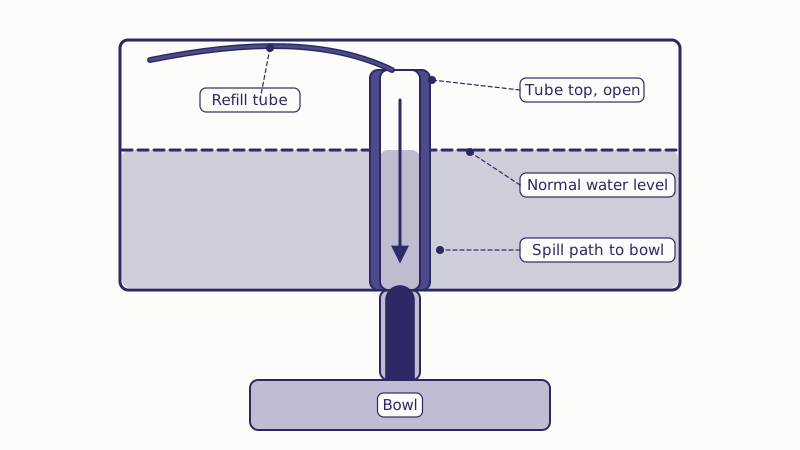
A toilet overflow tube rarely needs repair on its own. If water runs down it constantly, you fix the water level, the refill tube or the fill valve. If the tube itself is cracked or the flush valve around its base leaks, you replace the flush valve, which includes the tube. Our toilet repair page covers the parts around it.
Do not confuse this with a toilet overflowing onto the floor. That is a clog. See how to repair a blocked toilet and plumber for clogged toilet for that.
What does the toilet overflow tube do?
The overflow tube is a vertical pipe inside the tank that drains into the bowl. If the fill valve fails and the tank keeps filling, water goes down the tube instead of over the tank's rim and onto your floor. It also gives the refill tube a place to send water to refill the bowl after a flush.
In a traditional gravity tank, the tube is part of the flush valve, the assembly at the bottom of the tank with the flapper seat. Wikipedia's article on the flush toilet shows it as one of the standard parts of a US tank. The top of the tube sits above the normal water line, and the water should stop about an inch below it.
That is why a toilet that runs into the tube is a warning, not a flood: the tube is doing its job, and something upstream, usually the fill valve or float, is not closing.
Why is water running into the overflow tube?
Water runs into the overflow tube when the tank fills above its intended level, so the extra goes down the tube. The causes are a float set too high, a fill valve that does not shut off, or a refill tube pushed down into the tube so it siphons. Fix the level first, then replace the fill valve if needed.
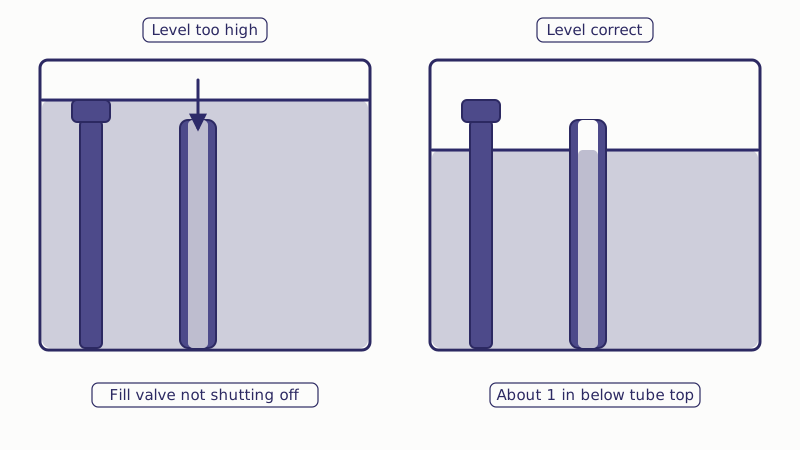
Check in this order:
- Water level. Look at where the water stops. The usual target is about one inch below the top of the overflow tube, or at the fill line marked inside the tank. If it is higher, lower the float with the adjustment screw or clip. Our fill valve page shows how.
- Refill tube. The thin flexible tube from the fill valve should clip to the top of the overflow tube, with its end above the water line. If it is pushed down into the tube below the water, it can siphon water out of the tank.
- Fill valve. If lowering the level does not stop the flow, the valve is worn and should be replaced.
- Flapper. If the level is correct but the tank refills every few minutes, the flapper is leaking, not the tube. See toilet flapper repair.
EPA WaterSense says a constantly running fill valve can pass 0.5 to 3 gallons a minute, and a leaking toilet could waste about 200 gallons a day. A tube that sounds like a quiet trickle can be an expensive trickle.
Can you repair a cracked or leaking toilet overflow tube?
A cracked overflow tube is not usually repaired, because the tube is molded into the flush valve. You replace the whole flush valve assembly. A leak where the flush valve passes through the bottom of the tank is also fixed by replacing the flush valve and its rubber seal, which is a bigger job than a flapper change.
Signs that point to the flush valve, not the tube's level:
- Water seeps out from under the tank at the center, not at the bolts.
- The tank loses water even after a new flapper, and the dye test is clear.
- The top of the tube has a visible crack or a chip.
Replacing a flush valve means taking the tank off the bowl. The steps are the same as a tank bolt repair: shut off the water, empty the tank, disconnect the supply, remove the bolts, lift the tank, remove the old valve with its large nut, fit the new one with its new seal, and reassemble with new tank washers. Not hard, but awkward. Some people want a plumber for it because a mistake leaks onto the floor and a tank dropped on the bowl cracks both.
Some repair kits let you replace the flush valve without removing the tank, but the results depend on the model, so read the instructions for your toilet before you buy.
What if the overflow tube is too tall or too short?
A tube that is too tall means the tank water level has to sit higher to flush properly, and a tube that is too short may flush weakly or run. Tubes are sized to the tank, and the fill valve height has to match. Match the replacement to the model, and set the critical level mark on the fill valve above the tube.
The critical level, marked CL on many fill valves, is the point the valve manufacturer says must be at least an inch or so above the top of the overflow tube. This keeps tank water from being pulled back into the supply in a rare loss of pressure. If you install a new fill valve, set that height before you tighten the nut.
Toilets with unusual tanks, such as low-profile models, use different valves. Take the old flush valve or the toilet's make and model to the store, so the new one fits.
What does it cost to repair a toilet overflow tube?
Adjusting the level costs nothing. A fill valve replacement runs about $60 to $200 from a plumber, per published 2026 guides, and the part is $10 to $40. Replacing a flush valve costs more than a flapper job because the tank comes off, so published guides put it in the upper part of the typical $150 to $390 range for toilet repairs.
Those are national guides, so treat them as a guide. In Los Angeles the Angi average for a toilet repair is about $290. The final price depends on your toilet, how old the parts are and what the plumber finds. A written quote comes before any work starts. If the toilet is old and the tank is cracked as well, the plumber may suggest a new toilet. Look at the replacement cost guide before you decide.
To book a visit, use the quote page. A local plumber comes to you. See City of Angels Plumbing for the service overview.
Common questions
How long does a toilet overflow tube repair take?
Adjusting the water level takes a few minutes. Replacing a fill valve is a short job, and replacing a flush valve takes longer because the tank must come off the bowl. A plumber can tell you more once they see the toilet, and an older toilet can add time.
What should I ask before I hire someone to repair a toilet overflow tube?
Ask which part is actually failing, since many people say overflow tube when they mean the fill valve or the flapper. Ask whether the quote covers the flush valve, new tank washers and the gasket, and what the service call fee includes.
Does someone need to be at the property?
Yes, or someone must give access to the bathroom. The toilet is out of service while the water is off. It helps to be there to say when the running started and to test the toilet when the work is done.
Is it normal to hear water going down the overflow tube?
Only briefly after a flush, when the refill tube sends a little water down to refill the bowl. Constant trickling, or a hiss after the tank is full, means the level is too high or the fill valve is worn. Adjust the level, then replace the valve if the sound continues.