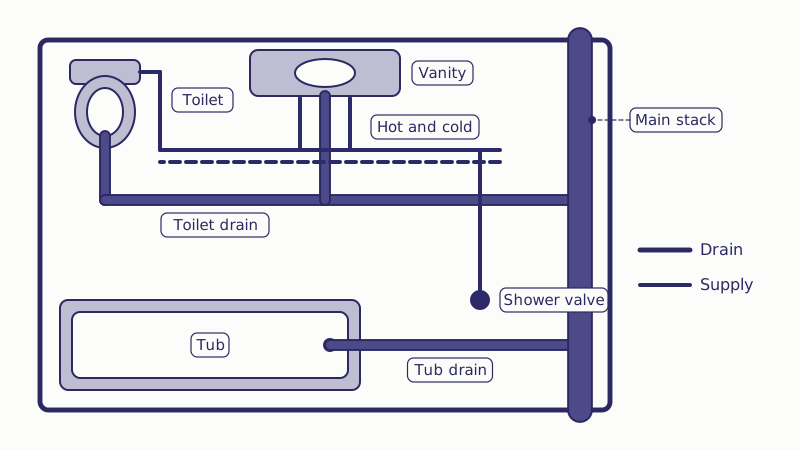
A bathroom remodel is a plumbing job as much as a design job. If the toilet, shower and sink stay where they are, the plumbing is a modest line in the budget. If any of them move, you are cutting into floors and walls, and the cost jumps. Before you pick tile, settle the layout, the valves and the permit. Everything on this page assumes a house or condo in the City of Los Angeles, and the plumber home page lists the other work we arrange.
What plumbing work does a bathroom remodel involve?
A remodel touches three layers of plumbing: the supply lines that bring in hot and cold water, the drain, waste and vent lines that carry water out, and the fixtures you see. Keeping every fixture in place usually means new valves and fixtures on the existing lines. Moving a fixture means new drain slope and new venting, which is far bigger work.
Plumbers think in three stages. Rough-in happens with the walls open: drains, vents, supply stubs and the shower valve body. Inspection comes next, before anything is covered. Finish comes last: faucets, trim, toilet, and showerhead.
Older Los Angeles homes add a wrinkle. A house from the 1920s to 1950s often has galvanized steel supply lines, which corrode from the inside, and cast iron or clay drains. When the wall opens, you see the real condition of the pipe. A bathroom remodel is the cheapest moment to replace a tired section, because the drywall is already gone. Ask the plumber to photograph what they find before the walls close, and you will have a record of what was replaced. If the lines to the rest of the house look bad, read about galvanized pipe replacement before you decide how far to go.
Do I need a permit for bathroom remodel plumbing in Los Angeles?
Yes, in most cases. The City of Los Angeles expects a plumbing permit when you add or relocate fixtures or lines, and inspections follow. Swapping a faucet or showerhead in the same spot is usually treated as minor. Confirm your exact job with the Los Angeles Department of Building and Safety (LADBS) before work starts, because the answer depends on what you open up.
LADBS runs permits in four steps: pre-application, plan check where required, permit issuance, and inspection. Simple jobs on its express permit list skip plan check and can be applied for online. Owners, agents and contractors can each pull a permit, but an owner who pulls one takes on responsibility for the work.
California licensing law matters here. The Contractors State License Board (CSLB) says a license is required for any work that needs a building permit, and the small-job exemption (raised to $1,000 in 2025) does not apply if a permit is involved. In plain terms: if your remodel needs a permit, the plumbing has to be done by a plumbing contractor with a California license, not a handyperson. Ask for the license number and check it on the CSLB website before you sign.
Budget for the permit fee on top of the work. LADBS has an online fee estimator that counts fixtures, and final fees are set when you apply. Guides put typical plumbing permits at a few hundred dollars, but I would trust the estimator over any guide.
How much does bathroom remodel plumbing cost?
It depends mostly on whether fixtures move. Published Los Angeles guides put a like-for-like shower valve replacement at roughly $170 to $625, and plumbing rough-in with an unchanged layout at roughly $1,200 to $3,000. Moving a toilet or shower drain is a different order of money: estimates run from about $1,500 to over $10,000.
Treat those as a guide. Most remodel price pages are written by contractors and skew high, and your quote is the only real number. What moves it:
- Moving a drain. Waste lines need slope, so a move can mean opening a slab or cutting through joists. Moving a toilet a few inches costs less than moving it across the room.
- Slab versus raised floor. A house on a concrete slab means cutting concrete for any new drain. A raised foundation gives access from the crawlspace.
- Pipe material. Replacing old galvanized supply with PEX or copper changes the price. See PEX versus copper for the trade-offs.
- Fixtures you choose. A mid-range toilet runs a few hundred dollars. Wall-hung toilets, rain showers and body sprays need extra framing and extra supply lines.
- Access. Hillside homes, second-floor bathrooms and tight lots add labor.
Get the quote in writing before work starts. California limits a home improvement down payment to $1,000 or 10 percent of the contract price, whichever is less, and requires a written contract for projects over $500 with a payment schedule. If someone asks for half up front, walk away. For labor math, see how much a plumber costs per hour.
Which fixtures do I have to replace under California's water-saving rules?
If your Los Angeles home was built in 1993 or earlier, California Civil Code Section 1101 says noncompliant fixtures must go. That means toilets over 1.6 gallons per flush, showerheads over 2.5 gallons per minute, and interior faucets over 2.2 gallons per minute. Single-family homes were required to comply by January 1, 2017, and a seller must disclose any that remain.
A remodel brings the rule into the open. For alterations to single-family property, replacing all noncompliant fixtures in the house is a condition of final permit approval, not just the ones in the room you are redoing. Replacement toilets are rated at 1.28 gallons per flush or less, and replacement showerheads at 1.8 gallons per minute or less.
Check the stamp on the back of the toilet tank lid and the flow rating on the showerhead. If the toilet is an older 3.5 gallon model, it will fail. In practice you buy a WaterSense-labeled fixture and keep the box and receipt for the inspector. If you are selling, the same list appears on the seller's disclosure.
Which valves and pressure problems should be checked before the walls close?
Check the shower valve, the shutoff valves at each fixture, the main shutoff, and the house pressure regulator. A remodel is the one time all of them are easy to reach. A failure behind a finished tile wall means demolition to fix, so replace anything tired now.
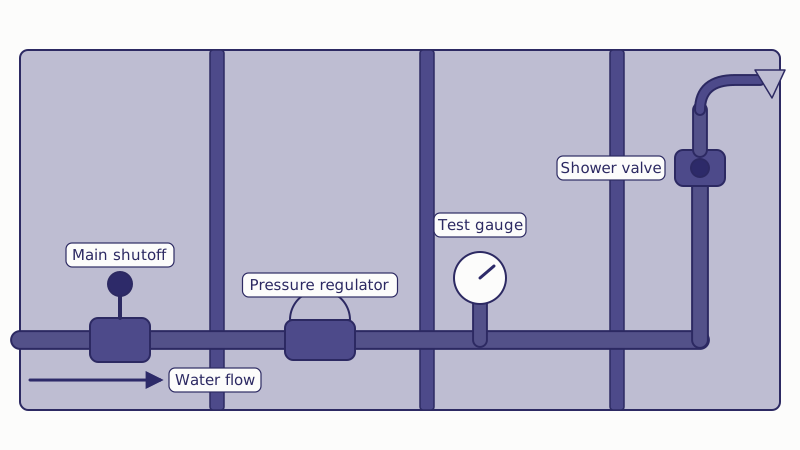
Here is the short list:
- Shower valve. If the old valve is stiff, drips from the spout, or no longer matches your new trim, replace the body now. A cartridge swap later is easy, but a corroded valve body behind tile is not.
- Angle stops. The small shutoff valves under the sink and behind the toilet often seize or leak when turned after decades. Install new quarter-turn stops while the pipe is exposed. The price for swapping them is covered in replacing a shut-off valve.
- Main shutoff. Make sure it closes fully, since you will rely on it during the work.
- Pressure. LADWP says new residential plumbing in the City of Los Angeles needs a regulator when street pressure can exceed 80 psi, and that older homes may have none. Regulators are owned and maintained by the property owner, usually set between 50 and 70 psi. If your faucets spit or the pipes bang, read about water pressure regulators. A failure here shortens the life of every new fixture.
Pressure runs high at many hillside addresses, and low at the top of some hills. LADWP can tell you the maximum and minimum for your address.
What should I settle before I call a plumber?
Settle the layout first, then the fixture list, then who pulls the permit. Plumbers quote from a drawing. A rough sketch with every fixture's position, plus the model numbers, produces a quote you can compare line by line instead of a guess.
Write down:
- Which fixtures move and by how far.
- Whether the home is on a slab or a raised foundation, and where the main shutoff is.
- The fixture models, so the plumber can price rough-in valves to match.
- Who handles the permit and inspections, in writing.
- What happens if the wall opens and the pipes behind it are failing.
If you are also redoing the kitchen or adding a bathroom, mention it. A new bathroom is a different scale of work, covered under new construction plumbing. To get a written quote after a local plumber visits, use our quote page.
When should I call a plumber for a bathroom remodel?
Call before you start demolition, not after. A plumber who sees the open walls can flag failing pipe, a bad drain slope or a missing vent while it is cheap to fix. Call immediately if you find a leak, rust-colored water, or a drain that backs up.
Some tasks are legally off limits for DIY. Anything needing a permit needs a contractor with a California license under CSLB rules. Gas lines, such as for a bathroom heater, are regulated work. If you smell gas at any point, leave the building, then call SoCalGas at 1-800-427-2200 from outside, and call 911 if there is danger.
Water and electricity share bathrooms. Switch off the circuit at the panel before you open a wall near a light, fan or outlet. Never touch a wet fixture while a circuit is live.
Common questions
How long does plumbing for a bathroom remodel take?
Rough-in plumbing for a bathroom with the layout unchanged commonly takes a day or two, with inspection after. Moving drains or opening a slab adds days. Total remodel time depends mostly on tile, waterproofing and permit inspection scheduling, not on the plumbing alone. Ask the plumber for the rough-in and finish dates separately, because the finish happens near the end.
What should I ask before I hire someone for bathroom remodel plumbing?
Ask for the CSLB license number and check it online. Ask who pulls the permit, what the written quote covers, and what the down payment is. California caps it at $1,000 or 10 percent of the contract, whichever is less. Ask what happens when hidden pipe damage turns up, and how change orders are priced before they are done.
Does someone need to be at the property?
Someone should be there for the first visit, for any water shutoff, and for the inspection, since the inspector needs access. In between, many owners leave a key arrangement with the general contractor. If you live in the house during the job, plan for the water to be off for several hours at a time, and ask for a heads-up before each shutoff.
Does moving a toilet cost much more than leaving it in place?
Usually yes. Leaving it means a new toilet on the existing drain. Moving it means a new drain at the right slope, a new vent connection and often floor repair. Guides range from about $1,500 to well over $10,000 depending on slab, joists and distance, so ask the plumber to price both layouts in writing.