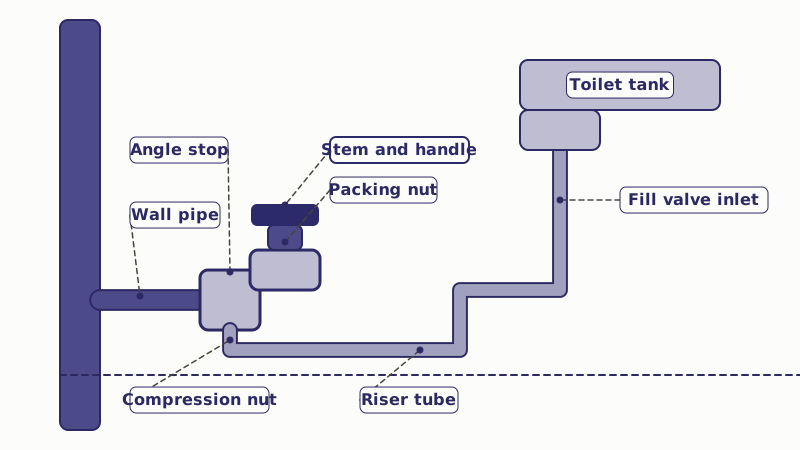
A toilet shut off valve repair usually means one of three things: tightening a packing nut that drips, replacing a valve that is stuck or corroded, or replacing the short supply line that connects it to the tank. If you can reach the valve, the part is cheap. The skill is in shutting the water off safely first. For the wider picture, start with our toilet repair page.
This page is for the valve itself. If the water is running inside the tank, the fill valve is a different part. If the toilet will not stop leaking at the base, see plumber for toilet leak.
What does the toilet shut off valve do, and why does it fail?
The shut off valve, often called an angle stop, sits between the water supply pipe and the toilet tank. Turn it and the toilet stops filling, so you can work on the toilet or contain a leak. It fails because it is rarely turned: internal parts corrode, seals harden, and mineral deposits lock the stem.
Most of these valves have a rubber washer or seat inside. A valve that has sat open for a decade or more can leave the washer stuck in place. When someone finally turns it, the washer tears, and the valve either will not seal or starts to weep at the stem. That is why an old valve is most likely to start leaking the day you first test it. Test yours on a day when you are home and have a bucket ready, not in the middle of an emergency.
Valves come in two common designs. A multi-turn valve has a round handle you spin several times. A quarter-turn valve has a lever that goes from open to closed in a 90 degree swing, and is generally less prone to sticking. Older homes tend to have the multi-turn kind.
Why is the toilet shut off valve leaking?
A leaking toilet shut off valve is usually dripping from one of three places: the stem under the handle, the compression nut where the supply line connects, or the joint where the valve meets the wall pipe. Where the drip comes from tells you whether a wrench or a new valve fixes it.
Wipe the valve dry, wrap a dry paper towel around each joint, and check them in a few minutes. The paper shows which one is wet.
- Wet at the stem, under the handle. Tighten the small packing nut behind the handle about a quarter turn. If that stops it, you are done. If it keeps seeping, the valve is worn.
- Wet at the supply line nut. Snug the nut by hand, then a small turn with a wrench. A cracked braided line or a crushed compression ring means a new line.
- Wet where the valve meets the wall. This is a threaded or soldered connection. Do not crank on it. A leak here is a plumber job, because forcing it can crack the wall pipe.
Leaks here deserve attention soon. Even a slow drip stains cabinets and floors and can rot subfloor. EPA WaterSense estimates that a leaking toilet can waste about 200 gallons a day, and while that figure is for a toilet tank leak, a supply leak adds up quietly too.
What can you try before replacing the toilet shut off valve?
Try turning the valve fully closed and fully open once, slowly, to free the stem, with a bucket and towel below it. If it turns and the drip stops, leave it alone. If it will not move, do not force it. A stuck valve that gives way suddenly can snap, and then the only way to stop the water is the main shut off for the house.
A quick check list before you decide:
- Put a towel and small bucket under the valve.
- Turn the handle clockwise, gently. Stop at the first sign of resistance.
- Flush the toilet. Turn the valve off. The tank should stay empty. If it keeps filling, the valve is not sealing.
- Turn it back on and confirm it opens fully. A valve that only opens halfway starves the toilet and causes a slow, noisy refill.
If the valve passes both tests and only the supply line leaks, replace the line. Supply lines are cheap, and a braided line is usually a simple hand-tight, then a quarter turn job. Do not reuse an old one if it has kinks or crusty fittings.
How do you replace a toilet shut off valve?
Replacing the valve means shutting off the water to the house, draining the line, removing the old valve, and fitting a new one to the wall pipe. If the wall pipe is copper, the new valve compresses on or is soldered. If the wall pipe is galvanized or corroded, the job grows, and a plumber should do it.
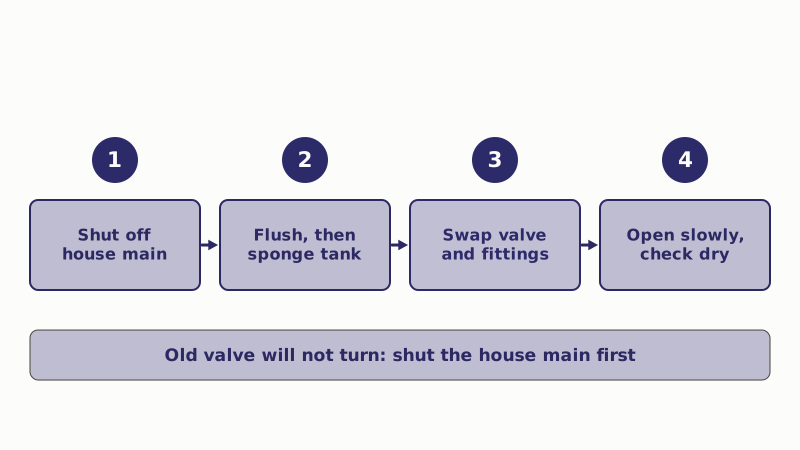
The compression-fit swap on good copper pipe goes like this:
- Close the house main shut off, flush the toilet, and open a faucet to drain the line.
- Disconnect the supply line from the old valve.
- Loosen the compression nut on the wall pipe and slide the old valve off.
- Slide on the new compression nut and sleeve, fit the new valve, and tighten the nut firmly but not hard enough to crush the sleeve.
- Reconnect the supply line, open the main slowly, and check every joint with dry paper.
If the wall pipe is soft, bent or crusty, or if the house main will not close, stop. A main that will not close is the real problem, and you want it fixed before an emergency. In California, anyone who contracts to do work worth $over $1,000 once labor and materials are added must hold a contractor license, and permits change the rule again. A valve swap is far below that, but a failed main or old pipe may not be.
What does it cost to replace a toilet shut off valve?
A plumber typically charges about $60 to $250 to replace a toilet shut off valve, including the part, according to published cost guides. The valve itself is $10 to $25 in parts. The spread comes from the service call, how easy the valve is to reach, and whether the wall pipe needs work.
Sources do not agree exactly. One guide puts it at $100 to $225, another at $130 to $250 including the supply line, and a third at $60 to $150. Treat these as a guide. The real price depends on your house and arrives as a written quote after the plumber sees the job. Los Angeles service call fees in published guides run about $75 to $250, which is why bundling the valve with other small jobs in one visit is cheaper than paying for two. Our guide to replacing a shut-off valve cost goes deeper on the price.
To get a visit, use the quote page. You can see how a job runs on how a job runs.
When should you call a plumber for a toilet shut off valve?
Call a plumber if the valve will not turn, leaks at the wall joint, sits on old galvanized pipe, or if the house main will not shut off. Also call if you have already tried a repair and it still drips. In each of these cases, forcing the valve risks a larger leak.
A local plumber we arrange for you comes to the house, replaces the valve if it is simple, and can also change a worn supply line while on site. They can add a quarter-turn valve at the same time, so the next repair is easier. Ask them to test the main shut off and to label it. Knowing where the main valve is and that it works is worth more than the toilet valve itself. If you have not looked at yours lately, our overview of City of Angels Plumbing shows how we arrange small repairs.
Common questions
How long does toilet shut off valve repair take?
Tightening a packing nut takes minutes. Replacing a valve on accessible copper pipe is a short job, often well under an hour once the water is off. Draining the line, reaching the valve and any pipe repair add time, so ask the plumber for an estimate when you book.
What should I ask before I hire someone for toilet shut off valve repair?
Ask whether the quote includes the valve and a new supply line, whether they will test the main shut off, what the service call fee covers, and what happens if the wall pipe is corroded. Ask for the CSLB license number and check it on the CSLB site.
Does someone need to be at the property?
Yes, or someone must give access to the bathroom and the water shut off. The water will be off for a while, so plan around it. It also helps to be there to see where the main shut off is and to test it with the plumber.
Can I just close the valve and leave a leaking toilet alone?
For a short time, yes. Closing the valve stops the toilet filling and limits damage until the repair. It is a stopgap, not a fix, and a valve that seeps while closed means it is worn. Plan a repair soon rather than living with a closed toilet.