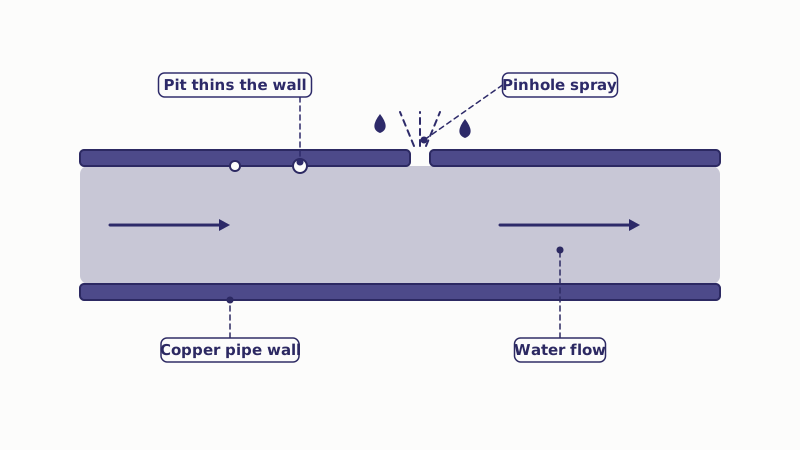
To stop a pinhole leak in copper pipe for now, shut off the water, drain the line, dry the pipe and cover the hole with a repair clamp, or with epoxy putty or self-fusing tape if you only need a few hours. All of those are temporary. The lasting fix is cutting out the damaged section and joining in new pipe. Our leaks and burst pipes hub covers other leak problems, and the home page shows how we arrange a visit.
How do you temporarily fix a pinhole leak in copper pipe?
Shut off the water, open a tap to drain the line and dry the pipe. Then press a clamp with a rubber pad over the hole and tighten it, or fill the spot with epoxy putty and let it cure, or wrap self-fusing silicone tape tightly around it. Restore the water slowly and watch. These are stopgaps until the section is replaced.
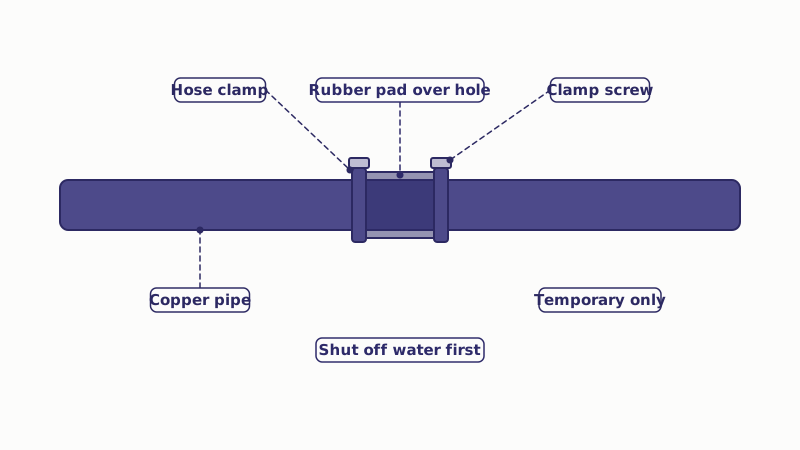
Pick by what you have and how long you need it to hold:
| Stopgap | Good for | Weak point |
|---|---|---|
| Repair clamp with rubber pad | A single pinhole on a clean, round straight pipe | Misses on a bent or corroded stretch |
| Epoxy putty or stick | A dry pinhole, hours to days | Needs a dry pipe and a full cure, fails under high pressure |
| Self-fusing silicone tape | A weep on a straight run | Not for hot lines at high pressure |
| Rubber patch and hose clamp | A fast roadside-style fix | Rough, short-lived |
| Push-fit coupling over a cut section | A real repair with no flame | Needs a square, clean cut |
The same rule holds for all of them. If the water is on and the patch is not clearly holding, shut the main and wait for a plumber. Do not leave a patched pipe over a ceiling or in a wall while you are away.
Our companion page on how to repair a copper pipe leak compares the permanent options.
Why do copper pipes get pinhole leaks?
A pinhole leak is the last stage of pitting corrosion, where a small spot on the inside of the pipe wears through the wall. A task force of the Copper Development Association concluded that the specific causes have yet to be determined. Water chemistry, flow speed, poor workmanship and microbes are all suspects. The practical lesson is that one pinhole often means thin pipe nearby.
That is why a second leak on the same line a few months later is common. A patch fixes one hole. If the pipe is old, a plumber may look at how many fittings, how much green staining and how many repairs the line already has. When failures keep coming, a replacement of the whole run costs less than repeated patching. See our repiping a house page for the larger option and the page on what causes a pipe to burst for the wider list.
Los Angeles water quality varies by service area. LADWP publishes its water quality report each year, and a plumber can tell you whether your pipe wear looks like pitting or something else. We would not guess at the cause for your house.
How do I find a hidden leak or tell if a pipe burst in the wall?
Run the meter test. Shut off every tap and appliance, then look at the leak detection gauge on the LADWP meter. If it moves, water is escaping somewhere. A burst in a wall often shows as a stain or bubble in the drywall, a hissing sound, a wet baseboard, a musty smell, low pressure or a bill that has climbed.
To narrow it down:
- Listen at walls with the house quiet. A hiss or trickle with everything off points to a live leak.
- Feel for warm spots on walls or floors, which can mean a hot line leaking.
- Look for stains, bubbling paint, warped baseboard and wet carpet edges.
- Isolate. If the house has zone valves, shut one at a time and watch the meter.
- Photograph stains with a date so you can see whether they grow.
If you can't find it, a plumber can use a camera, listening gear or a pressure test. Our guide to how to know if a pipe burst goes into more detail. A bulging wall or ceiling with water inside it should be treated as urgent.
How do I stop a water leak in the ceiling and dry it out afterward?
Shut off the main, keep people out from under a sagging ceiling, catch the drip and trace the source above. After the leak is fixed, dry everything within 24 to 48 hours, as the EPA advises. Run fans and a dehumidifier, and remove wet insulation and drywall that stay damp. Paint only when the material is dry.
The EPA says that in most cases mold will not grow if wet materials are dried within 24 to 48 hours, and that porous materials such as ceiling tile, drywall and insulation that stay wet beyond 48 hours are often best replaced. Do not paint or caulk over mold. A mold patch under about 10 square feet may be cleaned by a homeowner, and larger areas call for a contractor with mold cleanup experience.
Our ceiling water leak page walks through finding the source and the next steps. Most drying work is faster when the plumber opens the cavity, so ask for an access hole in the quote.
What if the leak is a PVC joint or a pipe outside the house?
A leaking PVC joint usually cannot be sealed lastingly. A glued joint that weeps often has to be cut out and replaced with new pipe and a coupling. For a pipe outside the house, shut the main, find the wet spot, and call a plumber. An underground supply leak is on your side of the meter, and LADWP does not repair leaks on private property.
For a temporary hold on a plastic joint, you can wrap tape or clamp a rubber pad, but plastic does not take epoxy as reliably as metal, and a joint under pressure will often keep weeping. See our guide on how to fix a leaking pipe joint for each pipe type. Our emergency plumber for a burst pipe page covers the case where water is pouring out.
After an underground leak is repaired, LADWP says you may qualify for a billing adjustment. Requests are made within 12 months, with repair receipts, and LADWP honors one request per 24 months.
When should a plumber take over?
Call when the leak is in a wall, under a slab or in a ceiling, when a patch will not hold, when the pipe keeps leaking, or when you do not know where the water is coming from. Under the Los Angeles code, replacing defective water piping in a dwelling with the same size and quality is exempt from a permit, while bigger changes are not. We'll arrange a local plumber to visit through the quote page.
A good written quote names the section being replaced, the pipe and fitting, the access hole and its repair, and any permit. Ask the plumber to check the pipe on either side of the leak. If the copper is thin, green or pitted, ask about replacing a longer run now.
Common questions
How long does a pinhole leak repair take?
A short section on an exposed pipe is often an hour or two once the water is off and drained. A pinhole in a wall or under a slab takes longer, because the plumber has to find the leak, open the surface, replace the pipe, test it and close up. Drywall and paint follow later. Ask for the schedule in the quote.
What should I ask before I hire someone to repair a pinhole leak?
Check the CSLB record at cslb.ca.gov, then ask whether the section will be replaced or only patched, what happens to the rest of the line, whether a permit applies and what is included for the wall. Get it in writing. California caps a deposit at $1,000 or 10 percent of the price, whichever is lower.
Does someone need to be at the property?
Be there, or have an adult you trust there. The plumber needs the main valve and the area around the leak, and the water will be off for part of the visit. You may be asked to approve more work if the pipe is thinner than it looked. Tenants should tell their landlord first.
Will epoxy or tape on a pinhole last?
Not as a lasting repair on a pressurized line. Epoxy and tape can hold for a short while on a dry, clean pipe, and some last longer, but plumbers treat them as stopgaps. They fail at joints and under higher pressure. Use one to buy time, and book a repair that replaces the damaged section.
Can one pinhole leak mean more are coming?
Yes. The Copper Development Association defines a pinhole leak as the final breakthrough of progressive pitting corrosion, so other pits may be forming nearby. A plumber can look at the line, count past repairs and tell you whether to replace a longer section. If failures keep returning, a planned replacement may cost less than repeated patching.