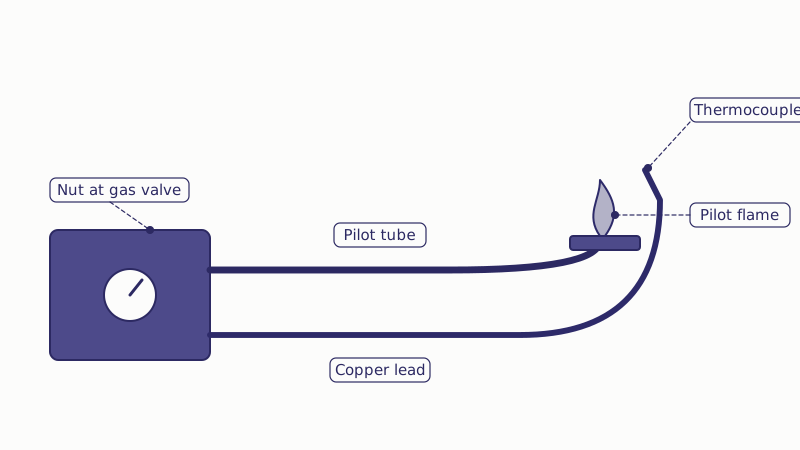
A thermocouple replacement is the right repair when a gas water heater's pilot light lights but goes out as soon as you release the button, or goes out by itself every few days. The part is a thin rod beside the pilot flame, and it tells the gas valve the flame is on. The part costs roughly $8 to $30, and published guides put a plumber's visit to replace one at about $150 to $300. It is one of the smaller repairs in the water heater repair and replacement range, but it sits on a gas control, so the safe course is to be careful about who does it.
What does a thermocouple do on a gas water heater?
A thermocouple is a safety sensor. It sits in the pilot flame and makes a tiny electric voltage, about 25 to 30 millivolts, while it is hot. That voltage holds the gas valve open. If the flame goes out, the voltage stops and the valve shuts, so gas cannot keep flowing into the room.
That is why the part matters. Without it, a pilot that blew out would keep releasing gas. When it wears out, it stops making enough voltage even with the flame lit, and the valve closes anyway. A heater with a standing pilot that will not stay lit is the most common gas water heater complaint, and the thermocouple is the most likely cause. Newer tankless water heater designs have no standing pilot at all. A thermopile is a related part on some "millivolt" heaters that makes much more voltage, so it is not interchangeable with a thermocouple.
How do you know the thermocouple has failed?
The signs are a pilot that lights but dies when you let go of the button, a pilot that goes out every few days, or no hot water and a cold burner with a pilot that will not relight. A soot-blackened or bent thermocouple tip supports the diagnosis, but a pilot problem can have other causes.
Before blaming the part, check a few things. A weak yellow pilot flame instead of a crisp blue one means a dirty pilot orifice. A draft, a blocked vent or poor gas pressure can also blow the flame off the sensor, and repeated failures after a new part point that way. These are reasons the replacement does not always fix it. Our page on water heater pilot light repair covers pilot problems that are not the thermocouple, and repair of a gas water heater covers the rest of a gas heater's parts.
Is it safe to replace a thermocouple yourself?
It is within the reach of a careful person with basic tools, but it is gas work. You shut off the gas, disconnect a fitting at the gas control, and relight the pilot. Overtightening can crush the part, and a poorly seated fitting can leak gas. If you are not sure, call a plumber.
If you do it yourself, the order matters: turn the gas control to off and close the gas supply, let the burner and flue cool (they run at high temperatures), disconnect the thermocouple at the gas control and the burner assembly, fit a part made for your heater, hand-tighten and then a small turn more, and relight the pilot following the label on the heater. Test the joint with soapy water and watch for bubbles. Universal parts fit many heaters, but newer sealed-chamber heaters may need the maker's pilot assembly.
If you smell gas at any time, leave the building, call SoCalGas on 1-800-427-2200 from outside, and call 911 if there is immediate danger. Do not use switches or flames. SoCalGas says only its own employees may turn the gas back on at the meter.
How much does thermocouple replacement cost?
The part itself is about $8 to $30, and a plumber's visit to replace it commonly runs about $150 to $300 in published guides. If the problem is the gas control valve rather than the thermocouple, a replacement costs more, about $250 to $500. These are a guide only, and a written quote sets the real price.
| Job | Published range (a guide only) |
|---|---|
| Thermocouple part | about $8 to $30 |
| Plumber visit to replace it | about $150 to $300 |
| Gas control valve replacement | about $250 to $500 |
| Replacing the whole gas water heater | about $1,350 to $2,400 |
On a tank that is past ten or twelve years old, a failing gas valve is often the point where replacement makes more sense than repair, so a quote that shows both is worth asking for. The water heater replacement cost page sets out the range.
Why does the pilot keep going out after a new thermocouple?
A new thermocouple that still fails to hold the pilot points to something else: a dirty or clogged pilot orifice, a draft or blocked vent, low gas pressure, a thermocouple not touching the flame, or a gas valve that is faulty. A plumber can test each of these.
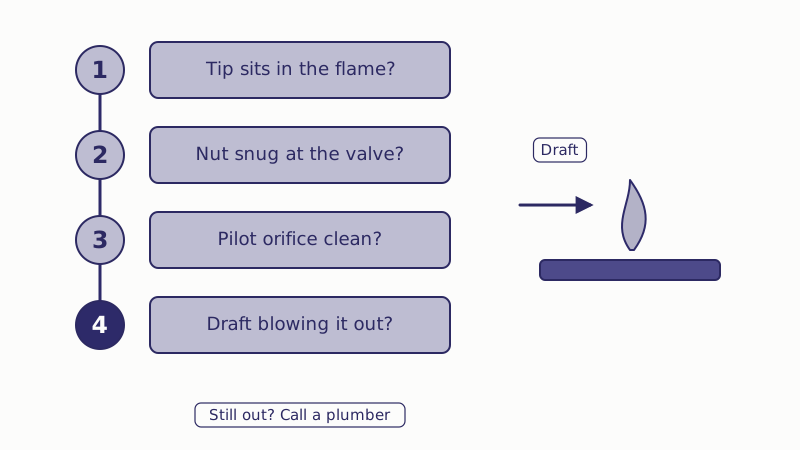
Check the basic position first, based on what the manual shows. The tip of the thermocouple must sit in the pilot flame. Then look at the flame color. If the flame is weak, the pilot tube or orifice is dirty. If the pilot works for a day and then goes out, a draft from a vent or a garage door may be the cause, and the vent should be checked. After an earthquake, SoCalGas advises checking water heater vents, because a separated vent can spill fumes into the home. Any heater you suspect of venting fumes into the home needs a plumber, not another part.
Does replacing a thermocouple need a permit in Los Angeles?
Often not, because it is a repair of a part and not a replacement of the heater, but ask the plumber. But a replacement water heater needs a permit in the City of Los Angeles, and LADBS requires one for a gas heater in a single-family home with a narrow exception for like-for-like swaps by a registered contractor. If a plumber advises replacing the heater, ask who is pulling the permit.
Gas work in California must be done by a contractor with the right license, and the state board lets you check a number on its website. For gas pipe changes or work beyond a part swap, see the plumber for a gas line page.
When should you call a plumber for a thermocouple problem?
Call if you smell gas, if you are not sure how to shut off the gas and relight the pilot, if the new part fails to fix it, if the heater is old and rusty, or if there is any sign of soot or fumes. A plumber can replace the part, test the gas joints and check the vent.
We can arrange a local plumber to come to your home, test the pilot and thermocouple, and give a written quote before any work starts. Tell us the heater's age and what the pilot does on the quote page. The home page lists the other jobs we arrange across Los Angeles.
Common questions
How long does thermocouple replacement take?
For a plumber, usually under an hour once the heater is cool. A do-it-yourself swap takes longer the first time, mostly for waiting on the burner to cool and testing the joints. If the plumber finds the cause is the gas valve or the vent, the visit takes longer and the cost changes.
What should I ask before I hire someone for this?
Ask for their California contractor license number and check it on the state board's site. Ask whether the quote covers the part, labor, a gas leak test and a vent check, and what happens if the thermocouple turns out not to be the problem. Ask for the price in writing.
Does someone need to be at the property?
Yes, someone should be there to show access to the heater and to see it working at the end. The gas to the heater is off for part of the visit, and the plumber will relight the pilot and check the flame with you.
Can a bad thermocouple cause a gas leak?
A failed thermocouple is designed to stop gas, not release it. When it fails, the valve closes and the pilot goes out. The danger lies in repeated relighting without finding the cause, or in poorly seated fittings after a repair. If you smell gas, leave and call SoCalGas from outside.
How long does a thermocouple last?
There is no fixed life. They often last several years, and they fail sooner when the pilot flame is dirty or drafty. A pilot that has started going out is the signal to replace it. A heater past about ten to twelve years is worth looking at for replacement as a whole.